

Did you know most business-to-business (B2B) sales are essentially closed before the buyer even speaks to a vendor? The latest research, based on observations from thousands of B2B sales, suggests buyers gather intel in silence for an average of six months before speaking with any sales representatives. In other words, if you’re not getting the lead volume you expect or your sales team is consistently missing targets, the real issue may be further upstream, during those six months of silence. To solve it, you need to build your online authority.
Below, I’m going to walk you through what’s actually happening behind the scenes with your B2B customers, how they make decisions, and what you can do to architect your online authority and win more business in the trust economy.
Your Reputation is the Currency of the Trust Economy
If you’ve used any online peer-to-peer service, whether it’s Uber to catch a ride, Airbnb for a vacation rental, or DoorDash to bring you medicine when you’re sick, you’ve experienced the most literal interpretation of the trust economy. You wouldn’t normally get into a stranger’s car or sleep in their home, but because you can easily see the provider’s reputation and the experiences of others on these platforms, you trust in the system, and you trust in the provider.
Globally, We’re Experiencing a Trust Crisis
The same system can work for you and your business. However, instead of maintaining your reputation on a single platform, you effectively have the whole internet to contend with, and the system is basically rigged against you unless you learn how to work from within it.
The first thing to know is that, even if you do the right things consistently and treat people well, it doesn’t always create trust. When asked if their business is highly trusted by their customers, 90 percent of executives say “yes,” PwC surveys show. In reality, just 30 percent of customers agree.
The general lack of trust people feel is a sign of our times, according to the latest Edelman Trust Barometer. The level of institutional trust has stagnated across most of the developed world. It has flatlined with a score of 55 out of 100 for years.
The Capacity to Trust Persists, But it’s Selective
Institutions are not impacted equally by the current climate. For instance, trust in the media has fallen, as has trust in governments. But to create the overall flatline we see, others have had to climb. Thankfully, one of those areas is brand trust, which has risen from 56 points to 68 during this overall period of stagnation.
And, our faith in our peers is holding on strong as well. This is reflected in the peer-to-peer platforms touched on earlier. We also see it reflected in online reviews. Roughly half of the population says they trust the opinions of strangers online as much as they do the people they know in real life, according to Bright Local.
In other words, we can see that people still have the capacity to trust brands. Whether they trust yours depends on the information they consume. This is what makes reputation management essential for leaders and brands, but it’s not enough by itself. Authority and visibility play a role, too.
Strong Customer Trust Leads to Better Business Outcomes
The trust economy isn’t just theoretical. We can actually measure the impact of trust on business outcomes. For instance, 88 percent of people say brand trust is either important or a dealbreaker when choosing a company to work with, Edelman reports. Further, two in five say they’ve stopped purchasing from a company due to a lack of trust, per PwC.
Trust plays a role as the relationship continues, too. For example, 46 percent of customers say they purchase more from companies they trust, and 28 percent say they’ve paid more to work with a company they trust.
Referrals also get a boost, with 61 percent saying they’re recommending a company they trust to friends or family. These referrals are a growth multiplier on their own. Clients who come through referrals are more loyal, tend to spend more, and are more profitable.
Because all these factors directly impact the growth and profitability of your business, building trust and presenting your business as a trusted entity online must be part of your overall strategy. But again, it rarely happens organically. It’s something most leaders and businesses must mindfully architect.
Most Buyers Make a Decision About a Brand Long Before the First Contact
If you look at your customer relationship management (CRM) data, you’re likely to find that deals close within a couple of months of the first contact. Some may even close in weeks or days. Because of this, it’s easy to assume that the sales cycle is very short. However, this overlooks everything that happens before a prospect reaches out to you. The full cycle is much longer, they’re not talking to you for most of it, and they’ve largely made up their mind before reaching out.
Consider Phases, Not Just Funnels
Most of us are familiar with the concept of the marketing funnel. It’s the idea that customers pass through four stages when making a purchase: awareness, interest, desire, and action. It’s still a useful tool, particularly when you’re working through the customer journey and trying to ensure you’re meeting buyers with appropriate content for each stage. However, it doesn’t fully capture the nuances of modern B2B sales. Breaking the journey into two phases provides greater clarity.
Phase One: Selection
- Formation of the Buying Group: The selection phase begins with the formation of a buying group. This is the group of individuals within a company who either make the final decision or influence it.
- Buying Group Alignment: Once formed, the buying group agrees on what problem they’re trying to solve and forms a general idea of what the solution should look like.
- Individual Research: Members of the group research options independently.
- Shortlist Creation: Once everyone has had the opportunity to research solutions, the team shares their findings and creates a shortlist of favorites.
Phase Two: Validation
- Shortlist Leader Stress Test: Buying groups test their assumptions in various ways, trying to ensure they’re making the best decision. Generative artificial intelligence (AI) platforms like ChatGPT, Gemini, and Claude often come into play. They may also do demos or begin negotiations.
- Final Decision: Once the decision has been affirmed, the buying group moves forward with the forerunner.
B2B Sales Cycles Last Nearly a Year and Involve Multiple Stakeholders
The average B2B deal is valued at $250,000, according to 6sense data. There are typically ten people in the buying group, and it takes them just over ten months to complete the buying cycle. These figures climb even higher depending on the total number of vendors being compared. For each additional vendor up for consideration, the buying group and the number of months in the sales cycle each increase by two.
Prospects Avoid Your Sales Reps While Building the Shortlist
In an ideal world, you’ll catch a member of the buying group while they’re performing their independent research, thereby gaining the opportunity to influence the decision. In reality, they’re avoiding your sales team during this stage. Over two-thirds of buyers prefer an overall rep-free buying experience, Gartner surveys show.
Moreover, the selection phase comprises 60 percent of the journey, per 6sense. This means that for a full six months of the typical ten-month cycle, you aren’t hearing from the prospect. They are, however, engaging with your content heavily during this period.
The Leader of the Shortlist Usually Wins the Deal
When buying groups build their shortlist together, they typically order it by preference. The leader of the shortlist is typically the one they reach out to first, and that business wins the deal four out of five times, 6sense data shows. On the rare occasions the initial frontrunner is not selected, one of the other shortlisted vendors gets the deal 95 percent of the time.
That means in order to close a deal, you almost certainly need to be on the shortlist, you need to be at the top of the shortlist, and you have to earn that position without ever speaking to any of the buyers. Your digital marketing is key to making this happen, but it’s only going to be effective if you’ve established your online authority.
The Sales Process Can Stop for Many Reasons
For every buying group that begins contacting sellers, four or five more stop the process somewhere before they hit that point, per 6sense. This usually happens for internal reasons, such as a scope change or budget cut.
However, all is not lost. In the months leading up to contact, buying groups interact with content hundreds of times, which builds familiarity. This is important because 97 percent of buying groups shortlist at least one vendor they’re already familiar with, and 86 percent have prior experience with the winning vendor.
This gives us two essential learnings. First, your online authority initiatives will not reveal the full results upfront. It takes time to build a strong footprint, and even after that, you have a ten-month wait for those relationships to mature. Secondly, the real value kicks in when the buyers who dropped out of the process early resume the process later. At that point, contact volume can explode because you have both streams reaching out. This isn’t an overnight solution, but the results compound if you stick with it.
Your Sales Team Still Serves a Vital Role
Buying groups don’t generally change their minds once they reach a consensus. The idea is painful. They’ve probably stopped and restarted their search repeatedly, and it can be difficult to get everyone to agree on a single solution. The more people involved in a decision, the harder it is to reach a consensus. But that doesn’t mean your sales team can coast on these sales, either.
Find Out if You’re the First Call
Have your sales team ask prospects if your business was the first one they called. If so, you’re likely at the top of the shortlist. Use that to your advantage and make the process as friendly and seamless as possible.
If You’re Not the First, Zero in On the Deal-Breakers
On rare occasions, when buyers change their minds and don’t sign on with the top vendor from their shortlist, it usually comes down to just a handful of reasons. By highlighting why your brand is the better fit in these areas, particularly when you can compare your offerings to the top competitor, you can still win the deal anyway.
- Technology: The most common reason buyers change their mind is that another solution was a better technology fit. This is the root of the switch 29 percent of the time, per 6sense.
- Pricing: Not far behind, at 28 percent, is pricing. Many will pivot if they are offered a better deal.
- Security or Compliance: Overall, 20 percent change their minds because they realize the shortlist leader might cause security or compliance headaches.
- Data Privacy: In 12 percent of switches, buyers have concerns about data privacy.
Unfavorable contract terms and stakeholder pushback also play a role, but to a lesser degree, and often not until late in the process.
Regulated Industries Operate Under a Different Credibility Standard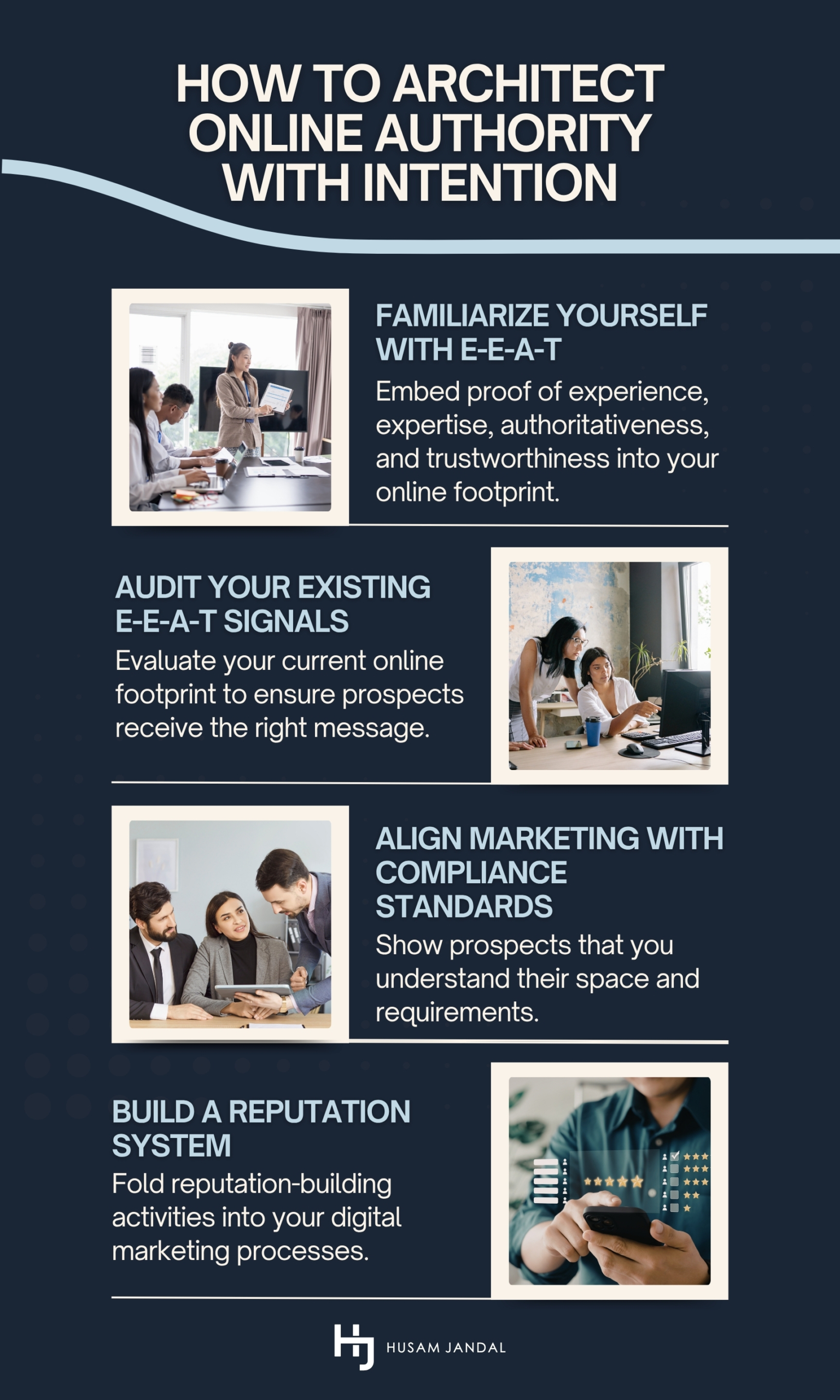
In B2B industries, it’s often very difficult for customers to leave. They build entire ecosystems and workflows around specific products and tools. For instance, if you use project management software, your entire history and future plans live on that platform. The idea of leaving it and trying to rebuild everything elsewhere is painful once it’s part of your everyday processes. You need to be sure you’re making an informed decision from the start. This is why the sales journey is ten months long in B2B. But if you’re in a regulated industry, there’s even more on the line, and the bar is much higher. This is no doubt why so many deals are lost to security or compliance concerns.
Buyers in Regulated Industries Have More to Lose
Google coined the term “Your Money or Your Life,” often shortened to YMYL, more than a decade ago. They used it internally to identify webpages that could cause direct, real-world harm to users if any information shared was low-quality, inaccurate, or misleading.
Back then, the YMYL designation was used more as a ranking factor. High-quality YMYL pages would rank higher, and low-quality YMYL pages would drop to the bottom of search engine results pages (SERPs). However, due to algorithm updates, YMYL pages that fail to meet high standards for trust and safety are increasingly being deindexed or are not indexed to begin with.
It’s probably easy to see the value of this on the business-to-consumer (B2C) side. For instance, if a website promotes a supplement, but it’s not a reputable website, and there’s no affiliation with a medical professional, that’s not something Google wants in the first position in the SERPs. And we, as consumers, don’t want it there, either.
The same premise exists in B2B. It’s just not widely talked about. If you’re in a highly regulated industry, it’s specifically because businesses in it have greater potential to do harm than others. Further, if your website covers topics that, if low-quality, inaccurate, or misleading, can harm a business’s operational success or financial health, it’s classified as YMYL, too. Because your buyers have more to lose, it’s up to you to prove that you deserve their attention and a top spot in Google.
Many B2B Industries Fall Under the YMYL Bracket
If you’re in any of the sectors below, the bar for credibility is higher, and the need to build trust is greater.
- Financial Services: This includes finance businesses that offer things like loans, factoring, insurance, accounting software, investment platforms, payroll, and tax prep.
- Legal and Compliance: If you’re a professional service provider that offers contract management, risk management, legal, and compliance services or tools, you should expect more scrutiny, too.
- Healthcare and Pharmaceuticals: Some examples here include providers of IT services for healthcare companies, telehealth platforms, or medical equipment manufacturers and sellers.
- Tech and Security: For instance, technology companies that offer enterprise security software, AI services, and critical infrastructure IT fit in this bracket.
Marketing Has to Work Inside Tighter Boundaries
Every industry and every jurisdiction has unique rules about what you can or cannot say and how information is presented.
For instance, virtually every jurisdiction has promotion rules for financial companies that essentially say all marketing must be fair, clear, and not misleading.
Businesses in healthcare and pharmaceuticals have their own rules. One of the most common requirements across jurisdictions is to share the risks of a product or service as clearly as the benefits. Depending on the nature of your business, privacy laws may also come into play.
While only the most educated buyers are likely to catch violations in your marketing, regulatory bodies tend to make any missteps they catch known as a way to protect the public. If violations persist, it can leave you with millions of dollars in fines, a shattered reputation, prison time, and more.
Inconsistency Creates More Suspicion
Overall, 69 percent of B2B buyers say they’ve spotted inconsistencies between information on a sales organization’s website and what has been provided by the sellers, according to Gartner. These aren’t just hiccups for a B2B buyer. These are breaches of trust.
Remember, by the time a buyer reaches out to you, there’s a good chance they’ve already made the decision to choose your business. They’re only validating that they’ve made the right decision. If they learn during the validation phase that even one of the factors on which they built a decision is inaccurate, they question the credibility of your business and your team. They become suspicious of everything they thought they knew, and it often halts the process.
Architect Your Online Authority with Intention
Roughly half of your audience is influenced by what you say, Edelman surveys show. Meanwhile, six in ten say others’ experiences influence their opinions. But seven in ten say it’s their own experiences with a brand’s products, service, or website that shapes their position. If your goal is to architect your online authority and build the kind of trust that lands you at the top of the shortlist, you’ll need to leverage a strategy that touches on all these areas with a deep focus on what the buyer experiences directly with your brand. We’ll dig into what that looks like in practice below.
Familiarize Yourself with E-E-A-T Guidelines
Earlier, we explored the concept of YMYL content and how Google evaluates it more critically because it can affect someone’s money or life. What it’s looking for during these evaluations is proof of experience, expertise, authoritativeness, and trustworthiness, often shortened to E-E-A-T.
When you provide E-E-A-T signals on your website, it tells Google why it should trust you and, therefore, rank your content higher. But the same mechanisms matter to the buyers reading your content and help build trust with them, too, so integrating them everywhere you share content can amplify the impact.
Audit Your Existing E-E-A-T Signals
Before you begin making any changes, take stock of the various places your brand is mentioned online and consider whether they’re trust-makers or trust-breakers. This will help you determine where to focus your energy when you move forward.
Website
Review your website through the lens of a potential customer. Is every page designed to help them accomplish what they need to? Are you following E-E-A-T guidelines and giving visitors reasons to trust you on every page? As you review your website, pay special attention to your:
- About Page: The about page is often one of the most-visited pages on a website. It helps humanize your business and build rapport. Use it to share your company’s origin story, mission, and values, so visitors connect emotionally.
- Bios: Whether shared on the about page or on their own page, bios bridge the gap between a corporate entity and the individuals behind it and can help foster an emotional connection. They can also serve as proof of expertise to further reinforce trust.
- Credentials, Accreditation, and Awards: Some businesses create a dedicated page that highlights any external validation they’ve received from reputable third parties. This is helpful, but they also need to be sprinkled around your website. Drop images of your awards in your footer, place security badges near contact forms, and find ways to highlight any special licenses or professional association logos, so they can provide immediate, visual proof of legitimacy.
- Disclosures and Transparency: In regulated industries, you may be required to provide disclosures and transparency statements, such as potential limitations of your offerings or conflicts of interest. In others, it’s simply the right thing to do. For instance, sharing details upfront about how you handle dissatisfied customers and refunds, or whether you have rules about cancelling services, shows that you’re not hiding anything and can help skeptical prospects feel more comfortable moving forward.
Reviews
Even though AI has taken the world by storm, most people still check reviews. In fact, 49 percent say they trust online reviews as much as they do the people they know in real life, according to Bright Local. Naturally, they care about sentiment or star rating when exploring reviews, but recency and volume are also factors in weighing reviews. Take a look at any review sites you’re mentioned on and evaluate your reputation. The average person now uses six different review sites, so don’t stop at one or two.
Search Results
Run a search for your business or services on Google. In non-branded searches, your position relative to the top result is a solid indicator of the trust Google is placing in you. The higher you rank, the more people will view you as trustworthy as well.
Visibility in special features such as the “Local Pack” or top-ranking local results, and having your Google Business Profile appear for branded searches, are also powerful indicators of credibility.
Keep an eye out for other general mentions of your brand in the SERPs, too. You might find complaints, review sites you didn’t know about, or even content others have created about your company.
Social Presence
Next, head to your social media profiles. Confirm whether you’re active enough to reassure people that you’re a lasting and ongoing presence and that your activity helps humanize your brand. But bear in mind, user-generated content is important too. Seeing other users’ experiences and feedback on platforms builds authenticity, which acts as a mechanism to build trust and increase purchase intent.
Also, keep an eye out for comments people have left, and whether you responded right away. Each of these interactions shows that you care and can boost trust.
Generative AI
Check what top platforms like ChatGPT, Gemini, Claude, and Copilot say about you. Adoption of the technology is growing rapidly, and people use it in different ways.
For instance, Edelman surveys found that 55 percent of people use generative AI platforms, and 91 percent of them use them for shopping.
Meanwhile, surveys from 6sense revealed that 94 percent are using LLMs as part of the B2B buying process, though typically not until the validation stage.
Many also use these platforms to check reviews. While Google is still the top source, with 71 percent of people using it to verify business reputations, ChatGPT and other generative AI tools are used to gather recommendations by 45 percent of the population.
Directory Listings
Appearing in multiple reputable directories signals to customers and search engines that a business is legitimate and established. Unfortunately, many businesses overlook them when information such as phone numbers, addresses, and hours of operation change, leading to inconsistent listings that can erode trust.
Align Marketing with Compliance Standards
If you’re in a highly regulated industry, how, when, and where you may present your business are determined by government agencies. Naturally, this means compliance is essential to keeping your doors open. But it also serves one other valuable purpose: it shows prospects that you understand their space and requirements.
Standardize Claims Language
Many industries and jurisdictions have specific requirements for the types of claims your business can make and whether those claims need a disclaimer. If these rules apply to your business, determine exactly how you want to present any claims and use the same language consistently. This can help protect your business and reassure prospects.
Create a Review Process
Always get a second set of eyes on content before it gets released. Even if your content creator is an expert who understands all compliance standards, they may still forget requirements from time to time or produce content that comes across differently than intended.
To ensure this review occurs each time, and that you can track when it happened and who was involved, formalize the process. For instance, you may have the content creator upload it to your marketing project management system and mark it for review or tag the person responsible for reviewing.
If multiple reviewers are required, or various members of leadership prefer to sign off on content before it gets shared, ensure you structure deadlines with plenty of time for this to occur, and that everyone involved knows whether reviews should be performed in a chain or if reviewers can jump in in any order.
Keep Content Current
Some content is evergreen, meaning it retains its value for years after publication. It’s also free of sensitive data and dates. However, much of the content you publish will have a shelf life. Create a refresh schedule and make sure you’re updating articles and webpages regularly to maintain freshness. This can help with compliance and ensure you have consistent messaging. It also signals to Google that your website and content likely reflect the most recent and accurate information, which improves rankings.
Build an Online Reputation Management System
Many businesses don’t think about their online reputation until they have a crisis. For instance, a prospect might ask what happened with a specific reviewer who left a poor rating, and it’s only then that they realize this review has been up for months or longer, likely eliminating them from shortlists all along. Or, they might get a single bad review and catch it in real time, but still feel helpless as their overall score plummets due to a low number of reviews. When you build a reputation system and are continuously strengthening your presence and reputation, these things are less of a concern. Moreover, you’re not frantically trying to fix damage after it has been done.
Monitor Mentions and Reviews
When you can claim a profile as your own and be notified if reviews come in, do so. Otherwise, set up a social media listening tool or Google Alerts to let you know when people mention a branded term of yours online, and create a schedule to manually check review sites for activity.
Respond Promptly and Professionally
Nearly 90 percent of people expect businesses to respond to reviews that are left, per BrightLocal surveys. While 81 percent say they expect that response to arrive within a week, 19 percent say it needs to be posted on the same day the review was left.
It’s also worth noting that templated responses don’t work here. They make half of all readers unlikely to choose your business. Instead, create general guidelines on how your team should frame responses, and the freedom to tailor them to suit each situation.
Keep compliance in mind here as well. If your business has data that’s protected by law, it can’t slip out in public replies even if you’re genuinely trying to help a customer. Always thank the reviewer and ask them to move to an alternate channel for further discussion. The same is true for any dissatisfied customer. Oftentimes, how you address the complaint matters more to readers than whether an issue occurred.
Ask for Reviews
As touched on earlier, volume and recency of reviews influence perception. Nearly half of all readers won’t work with a business that has fewer than 20 reviews, per BrightLocal. Close to one-third say they only care about reviews written in the past two weeks, and one in five say the reviews only matter if they’re from the past week.
Thankfully, the fix here is simple—just ask for reviews. In all, 83 percent of people say they’ve left a review within the past year after being asked to do so, and 28 percent say they always do it when asked.
Create High-Quality Niche-Specific Content
To be seen as a thought leader and reliable source of information, develop a content release cadence and calendar. Focus articles on topics specific to your niche to demonstrate you’re an authority on the subject. To help maximize your reach and secure more backlinks, optimize and promote them.
Strengthen Your Social Media Footprint
Identify which social media platforms your customers use. For B2B, that usually means LinkedIn and Facebook at a minimum, but don’t assume this is where yours will be. Research and confirm to ensure your messaging reaches the right people and that you’re not pouring resources into maintaining platforms that don’t provide value.
Once you have selected your networks, ensure all static information, such as the about section and contact details, is up to date. Then, develop a regular posting cadence you can stick with, and respond to any questions or comments people leave.
Don’t expect your social profiles to do any heavy lifting and deliver leads. Their real value in B2B is in building trust and authority, so you land on shortlists.
Build Relationships within Your Niche
Many businesses and business leaders take the time to connect with others in their industry on social media. That’s a good start, but take it a step further. Explore ways to collaborate.
- Referral Partnerships: We talked about the value of referrals earlier. These most often come from clients when you don’t have a formal plan in place. However, other businesses and professionals can send leads your way, too. Develop a referral partner program and provide reciprocal referrals to strengthen your presence and authority.
- Guest Blogging: Consider letting others post articles to your website when there’s a good fit. The expertise will reflect back on your business. You can also look for places outside your website to share your content to boost reach and increase awareness.
- Collaborative Content: Explore opportunities to work with industry partners on more complex content, such as podcasts, webinars, and whitepapers. This will help solidify your reputation as a thought leader and industry expert, plus let you reach new audiences without having to manage the full production alone.
- Influencer Marketing: The right influencer can give you instant credibility within a niche. To start, focus on micro-influencers with small but engaged audiences.
Get Help Architecting Your Online Authority
Trust and authority are not built overnight. They’re the compound result of months or years of consistent effort. That’s why I fold these strategies into every digital marketing tactic I deploy for my clients from day one. If you’re interested in developing a comprehensive digital marketing strategy that prioritizes the long-term health and success of your brand, let’s talk. Connect with me for a complimentary consultation.
FAQs on Building Online Authority in the Trust Economy
What is the trust economy, and why does it matter?
The trust economy is a business environment where credibility strongly shapes who gets attention, consideration, and sales. Buyers research independently, compare options early, and often form opinions before speaking with anyone. That makes trust a growth factor, not just a branding goal or reputation issue.
How do I build online authority as a professional?
Build online authority by showing up consistently, publishing useful insights, earning validation from credible sources, and making your expertise easy to verify. Your website, LinkedIn profile, interviews, articles, reviews, and speaking appearances should all support the same professional narrative and reinforce each other over time.
What are the key signals of digital credibility?
Digital credibility comes from clear expertise, consistent messaging, current information, strong reviews, recognizable clients or partners, third-party mentions, polished profiles, and content that demonstrates real knowledge. Buyers also notice response quality, professionalism, and whether your online presence feels complete, active, and aligned across platforms.
How can I measure my online authority?
Measure online authority through both perception and performance signals. Look at branded search volume, referral traffic, review quality, backlink quality, media mentions, engagement from the right audience, shortlist wins, consultation rates, and close rates. If trust is rising, better-fit prospects usually move forward with less resistance.
How does thought leadership build trust?
Thought leadership builds trust by helping people see how you think before they ever speak with you. When your content is clear, useful, and grounded in real expertise, it reduces uncertainty. It also signals that you understand the market, can explain complexity, and are worth taking seriously.
What platforms are best for building authority?
The best platforms are the ones your buyers actually use to research and validate options. For many B2B businesses, that includes a strong website, LinkedIn, review platforms, industry publications, podcasts, and selective social channels. The goal is coverage across the places prospects naturally check.
How do you start authority marketing?
Start by auditing what buyers currently see when they research you. Then tighten your positioning, update your core profiles, strengthen trust signals, and create content that answers real buyer questions. Authority marketing works best when your website, social presence, proof points, and third-party visibility all support one message.
What is digital trust?
Digital trust is the confidence users have in an organization's ability to protect their interests and provide accurate, safe information online. It is the outcome of meeting high standards for safety and transparency, especially in "Your Money or Your Life" industries where low-quality information can cause real-world harm.
How does having a thought leadership strategy help you build online authority?
A thought leadership strategy helps by making authority intentional instead of accidental. It gives you a plan for what to publish, where to show up, and how to reinforce expertise over time. That consistency helps buyers recognize your perspective, remember your brand, and trust your credibility faster.

































































Husam Jandal
Husam Jandal is an internationally renowned business and marketing consultant and public speaker with a background that includes training Google Partners, teaching e-business at a master’s level, receiving multiple Web Marketing Association Awards, and earning a plethora of rave reviews from businesses of all sizes.