 Nobody talks about intellectual property (IP) in business, but it’s one of the most powerful things a company can possess. Think of it this way: have you ever noticed how some companies seem to come out of nowhere overnight and then sell for millions or even billions of dollars?
For instance, the personal finance software Mint launched in 2006, then was acquired by Intuit in 2009 for $170 million. Jet.com, the e-commerce startup, is another prime example. It launched in 2015, then was purchased by Walmart for $3.3 billion in 2016.
One of my favorite “overnight success stories” is Interstate Capital. Although more mature at the time of acquisition, it experienced exponential growth during its final years with its founders and ultimately received a buyout offer of over $100 million. I know this particular story well because I was a part of their journey.
When people talk about these businesses and others like them, the focus is almost always on their rapid growth and sales price, as if it’s a mystery how they got there. But the reality is that we do know their secret: intellectual property.
Mint’s edge was its proprietary algorithms; Jet.com’s was its optimization tech; and Interstate Capital’s advantage came from tools that simplify client workflows and a branded platform to attract a steady flow of high-value prospects.
These varied examples tell us something else important: intellectual property is something virtually any company can create. In fact, you may already have it and just not realize that you do. Give me a few minutes, and I’ll walk you through what intellectual property in business is, why it gets overlooked, and how it can create real value for your company.
What Intellectual Property in Business Really Means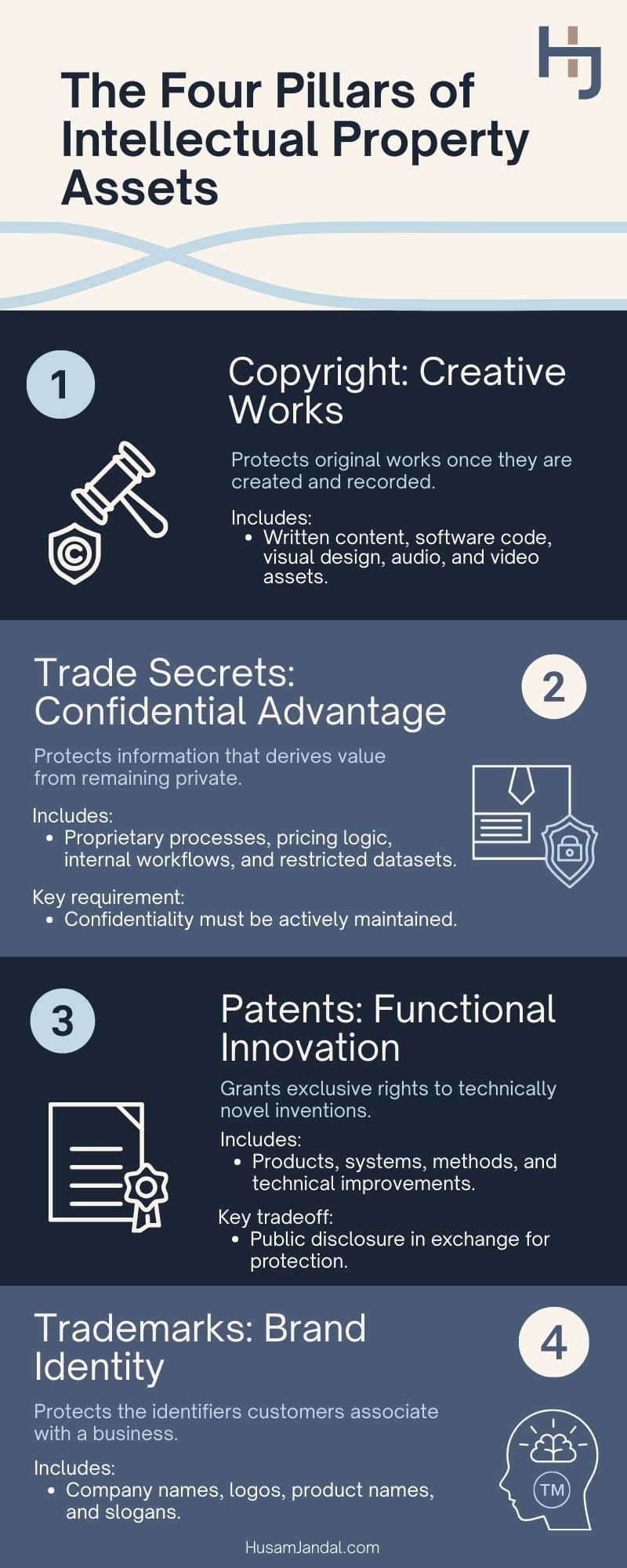
Some things are tangible, meaning you can generally physically hold them or touch them, and they have finite value. In business, examples of tangible assets include things like your inventory, vehicles, machines, or even your building.
Other things are intangible, meaning they’re non-physical resources that have long-term value. This includes things like brand recognition and your customer relationships.
Intellectual property is a specific type of intangible asset. What sets IP apart is that it’s owned and legally protected by a business, so it can’t be used or implemented by an outside party without consent.
Intellectual Property is Virtually Anything You Build That Can Be Reused
People tend to have a rigid idea of what IP looks like. For instance, we can all recognize logos from tech giants like Apple and Google. But IP is much broader than this. It can be virtually anything that has:
- Repeatable Advantage: In other words, you can use it again and again without having to rethink or rebuild it, and you receive value from it every time it is used.
- Transferable Value: It can be handed to someone else and still work the way it was intended.
- Defensible Differentiation: It sets your business apart from others, often becoming the reason customers choose your brand or stay with you.
There Are Four Main Types of Intellectual Property in Business
Intellectual property is generally grouped into four categories. Each one protects a different kind of asset.
1. Copyright
Copyright protects original creative work once it is created and recorded in some form. You do not need to register it for copyright to exist, although registration strengthens enforcement and remedies. A few examples of assets that may be copyrighted are:
- Written Works: Virtually any written work, from articles to blog posts, whitepapers, reports, training materials, sales scripts, and internal documentation, can have copyright protection.
- Visual Works: Assets such as graphics, illustrations, photographs, slide decks, and design layouts fit within this category.
- Audio and Video: This includes things like podcasts, videos, webinars, recorded presentations, and onboarding content.
- Software and Code: The underlying code that powered Mint is a prime example here. This category covers areas like applications, platforms, dashboards, calculators, and custom-built internal tools.
2. Trade Secrets
Trade secrets protect confidential business information that derives value from not being publicly known. Unlike other forms of intellectual property, trade secrets are not registered. Their protection depends on the business actively maintaining the confidentiality of the information. Some examples of trade secrets include:
- Proprietary Processes: Internal workflows, fulfillment methods, pricing logic, and operational playbooks often qualify when they produce consistent outcomes and are not shared publicly.
- Proprietary Data and Insights: Customer behavior data, performance benchmarks, internal scoring models, and historical datasets can function as trade secrets when access is restricted.
- Methods and Know-How: Sales methodologies, negotiation approaches, and optimization techniques developed through experience often fall into this category.
This was one of the driving factors in Walmart’s acquisition of Jet.com. While the brand had value in terms of customers and an active platform, the purchase is largely seen as a strategic move to gain access to the company’s trade secrets, including dynamic pricing and the “save as you buy” methodology. Walmart also launched its associate delivery program shortly after the acquisition, an initiative Jet.com had been working on previously. Plus, the superstore picked up Jet.com’s team in the deal and allowed them to continue developing innovative ideas independently for a couple of years after the acquisition.
3. Patents
Patents protect inventions and functional innovations by granting exclusive rights for a limited period in exchange for public disclosure. They are typically used when a business creates something technically novel that competitors could otherwise replicate. A few examples of things that can be patented are:
- Product Innovations: New devices, machines, or manufactured components designed to solve a specific problem can qualify for patent protection.
- Functional Systems and Methods: Novel technical processes or methods that materially change how a task is performed may fall into this category.
- Applied Technology Improvements: Enhancements to existing technologies that introduce a meaningful functional difference can also be patented.
Apple is a dominant force in the patent world, having secured over 116,000 patents, according to GreyB. These cover everything from the way its touch screens operate to the shape of its phones.
4. Trademarks
Trademarks protect the identifiers customers associate with a business and its offerings. These marks help customers recognize the source of goods or services and distinguish them from competitors. Some examples of trademarks include:
- Brand Names: Company names, product names, and service names function as trademarks when they identify the source of goods or services.
- Logos and Visual Marks: Symbols, icons, and distinctive visual elements qualify when they are used consistently to represent a brand. For instance, most people instantly recognize the Nike swoosh.
- Taglines and Phrases: Repeated messaging or slogans can be protected as trademarks when they signal brand identity over time.
Intellectual Property Acts Like a Force Multiplier
One of the primary reasons businesses overlook IP is that it’s not always easy to see the potential value of an intangible asset. In reality, well-crafted IP can impact multiple areas of your business, and the value can compound over time.
It Gives You Capabilities Competitors Cannot Copy Freely
Protected assets, whether a brand name, a process, a piece of software, or a dataset, give your business an advantage that others cannot duplicate. This means even when other brands see the value in what you’re doing, and want to copy you, they can’t. While they may be able to somewhat emulate what you’re doing with time and effort, it won’t be the same as the original offering customers know and love.
This was one of the reasons Interstate Capital’s IP was so successful and brought the company incredible value. It was the first mover in its industry on a novel concept. Today, others have offerings that emulate it, but it took them considerable time and effort to build their own versions.
It Makes Your Business Harder to Replace
When customers rely on your systems, tools, or methods, it becomes part of how they operate. This improves customer stickiness. The more they rely on you, the more time-consuming and disruptive it is for them to change providers.
It Strengthens Recognition and Conversion
Distinctive assets such as names, logos, taglines, and frameworks help customers recognize your business faster and remember it more easily. This is fundamental to building trust and relationships, which in turn support virtually every marketing and sales effort.
It Scales without Additional Labor
Once created, IP can be used repeatedly without requiring a proportional increase in time or effort. Frameworks, processes, tools, and technology remain useful even as demand grows.
It Creates Pricing and Negotiation Power
When value comes from assets others do not have, pricing naturally shifts toward impact rather than comparison. Prospects understand they are choosing a specific approach or capability, which opens the door to stronger margins.
This is a key reason why the “cheapest” iPhone now costs around $600 new, while you can pick up a basic smartphone from another brand for closer to $150. It’s also why consumers rarely switch, even though the alternative may be easier on their wallets.
It Improves Team Efficiency and Consistency
Defined methods, documented processes, and internal tools help teams produce reliable results without reinventing work. This reduces errors, shortens training cycles, and raises the overall performance of the organization.
It Increases Long-Term Business Value
We’ve already seen this in action with Mint, Jet.com, and Interstate Capital. Simply put, acquirers routinely pay more for businesses with defensible assets. Proprietary technology, protected brands, and established processes contribute directly to valuation because they offer advantages that continue well into the future.
You May Already Have Unprotected Intellectual Property
Intellectual property often hides in plain sight. If you’ve built your business from the ground up, you’ve likely developed all kinds of assets and processes that are central to how you work and present yourself to the public. Before you begin developing new IP, it’s important to identify what you already have and protect it.
Start with an IP Audit
Begin by reviewing the assets your business relies on every day. Look at your written materials, visuals, product features, tools, processes, internal documents, customer-facing resources, data, and brand elements.
Your goal at this stage is simple: identify anything your team uses repeatedly or anything customers associate with your business. These are the assets most likely to warrant protection, even if they were created without IP in mind.
Safeguard Your Content
Copyright applies automatically in most regions. The moment a creative work is produced and recorded, the creator holds the rights to it. This includes written materials, designs, videos, software, and training assets.
Although registration is optional, it can strengthen enforcement. The process varies depending on where you’re located and where you want to have protection.
- United States: Businesses can register through the United States Copyright Office.
- Canada: Registration occurs with the Canadian Intellectual Property Office.
- United Kingdom: Registration is not required, but companies often retain timestamped versions of their work or use third-party verification services for added evidence.
- The Gulf Region: Registration is available through national intellectual property offices and can support enforcement if disputes arise.
Ensure Confidentiality

Internal systems, pricing logic, customer insights, formulas, datasets, and operational methods often qualify as trade secrets. Most countries follow the same general rule: trade secrets retain their value only when a business takes reasonable steps to protect them.
- Limit Access: Restrict who can view or use sensitive information so it is only available to the people who need it for their work.
- Store Materials Securely: Keep confidential documents, data, and tools in controlled systems that prevent unauthorized access.
- Use Nondisclosure Agreements: Have employees, partners, and contractors sign clear agreements that prohibit sharing or reusing protected information. Some businesses also layer in non-compete clauses in their contracts to prevent people with insider knowledge from using it elsewhere.
- Document Authorized Users: Maintain a record of who is permitted to reference, apply, or update the information so you can demonstrate reasonable protection measures if needed.
Protect Your Inventions
If your business has developed a new product, process, or technical improvement, patent protection may be available. The core principle is the same across regions: a patent grants exclusive rights for a set period, and no one else may use, sell, or reproduce the invention without permission. Application processes differ by region.
- United States: Applications are filed through the United States Patent and Trademark Office. Businesses often start with a patent search, followed by a provisional or full application.
- Canada: The Canadian Intellectual Property Office handles applications, and the process parallels that of the United States in many ways.
- United Kingdom: Applications run through the UK Intellectual Property Office and can feed into broader European protections.
- The Gulf Region: Patent applications are generally filed through national intellectual property offices, including the Saudi Authority for Intellectual Property. Some businesses may also explore regional filing pathways through the GCC Patent Office, which previously offered a unified system for member states.
Most companies work with a patent attorney or agent due to the technical nature of these filings.
Lock in Your Branding
Names, logos, icons, and taglines shape how customers recognize and remember your business. Trademark systems differ slightly by region, but the purpose is consistent: they prevent others from using confusingly similar branding.
- United States: Trademarks are filed through the United States Patent and Trademark Office.
- Canada: The Canadian Intellectual Property Office manages trademark registration.
- United Kingdom: Applications go through the UK Intellectual Property Office, and businesses may extend protection across the European market.
- The Gulf Region: Trademarks are registered through national intellectual property offices, such as the Saudi Authority for Intellectual Property.
Many companies secure both their business name and core product or service names to maintain clarity as they scale. Because trademarks are not universal, it’s advantageous to register with the World Intellectual Property Organization (WIPO). The Madrid System allows you to register through your local trademark office and choose which countries you’d like protection in, so you can register everywhere at once.
Monitor and Enforce
Every region expects rights holders to monitor the use of their IP. This is central to defending it as your property, should it ever be misused by another entity.
If misuse occurs, businesses often begin with a direct request or a cease-and-desist letter. If the issue continues, an attorney who specializes in intellectual property can guide the next steps based on local enforcement rules.
Developing a Business IP Strategy is Easier Than You’d Think
Another reason businesses overlook IP is that it can seem abstract. By definition, it is proprietary. It does not exist anywhere else, which means there is no standard template to follow and no obvious roadmap for developing it. Without clear direction, many teams assume it will be complicated or time-consuming and decide to postpone it. In practice, building IP is usually much simpler than people expect.
Create Internal Procedures
Establish a structure that supports creativity.
- Create a Culture of Innovation: Build a diverse team and ensure people feel safe sharing ideas, experimenting, testing early versions, asking questions, and challenging assumptions without fear of criticism.
- Build Clear Pathways for Contribution: This might include a documented submission method, clear review steps, and a consistent process for deciding which concepts advance.
- Allocate Time and Resources for Development: Innovation needs space. Set aside time, tools, and a modest budget to ensure promising ideas can be explored without competing with daily operational demands.
- Establish a Lightweight Review and Approval Process: Simple checkpoints, such as monthly evaluations or stage-based reviews, allow leadership to assess progress, refine direction, and support ideas that show potential.
Identify Gaps
Some of the strongest IP emerges from solving recurring challenges or unmet needs within the business. Instead of relying on external tools or piecemeal fixes, look for areas where a proprietary solution would offer an advantage.
- Identify Where Workflows Slow or Break Down: Internal dashboards, automated steps, or frameworks frequently originate here.
- Consider Ways to Meaningfully Improve Customer Experience: Tools and processes that bring clarity, speed, or consistency often evolve into assets customers depend on.
- Explore Ideas That Give the Business an Edge at Scale: If creating your own method or system leads to stronger performance than off-the-shelf options, it’s a natural place for IP development.
Use Provisional Patents as Needed
When you are developing something technically novel, a provisional patent can serve as a low-risk way to protect the concept while you refine it. A provisional application:
- Establishes an Early Filing Date: This creates a formal record of when the idea was first documented, which can be crucial if others begin exploring similar concepts.
- Provides 12 Months for Refinement: The provisional period gives you time to strengthen the invention, gather supporting data, or test variations before committing to a full application.
- Offers a Lower Cost Entry Point: A provisional filing requires fewer formalities and a smaller investment, making it a solid starting point for ideas that are still evolving.
- Supports Continued Experimentation: You can test, adjust, and improve the concept during the provisional period without losing the original filing date.
If the idea continues to show promise, you can move forward with a non-provisional patent. If it does not progress as expected, you can allow the provisional to lapse without significant investment.
Get Help Developing a Well-Rounded Digital Marketing Strategy
Intellectual property can be a force multiplier for your business, but you also need systems and structure that give it something to build on. That means ensuring your messaging is consistent, branding elements are used appropriately, value is clear, and differentiation is made. If you’d like help exploring what that might look like for your business, let’s talk.
FAQs on Intellectual Property in Business
What are the benefits of intellectual property?
Intellectual property helps your business stand out, improves customer recognition, and creates assets you can reuse without added labor. It also strengthens pricing power, supports expansion, protects technical innovation, and increases valuation. When protected early, IP becomes an advantage that continues to generate returns across multiple areas of the business.
What are the four types of intellectual property companies should protect?
The four primary types are copyright, trademark, patent, and trade secret. Copyright protects creative works. Trademarks protect brand identifiers. Patents protect inventions and technical innovations. Trade secrets protect confidential information that gives the business a competitive advantage. Together, they form a comprehensive system for safeguarding value.
What are the seven intellectual property rights?
The broader legal framework includes economic rights, moral rights, copyright, trademarks, patents, industrial designs, and geographical indications. Not all apply to every business, but they collectively define how creators protect and control their work internationally. Companies typically focus on copyright, trademarks, patents, and trade secrets for daily operations.
How does IP contribute to a startup’s valuation?
Investors value startups with strong intellectual property because protected assets reduce competitive risk, support premium pricing, and create pathways for scalable growth. Patents, proprietary technology, strong branding, and repeatable systems often influence acquisition interest and investment terms. In many cases, IP becomes the primary driver of valuation, especially early on.
What role does IP play in competitive strategy?
Intellectual property shapes competitive strategy by giving your business advantages competitors cannot duplicate. Protected assets strengthen customer stickiness, improve differentiation, and limit comparison-based pricing. They also help you enter new markets with confidence, since the core elements behind your offer remain protected. As a result, IP becomes a long-term strategic lever.
Can intellectual property be monetized?
Yes. Intellectual property can generate revenue through licensing, franchising, partnerships, productization, or selling the rights outright. Many companies also monetize IP indirectly through improved pricing power, stronger retention, and greater brand recognition. When the underlying asset is protected, it can produce income without requiring proportional increases in time or labor.
Are IP assets and business valuation linked?
Yes. Intellectual property often plays a direct role in valuation because it represents defensible assets that continue creating value over time. Acquirers routinely pay more for businesses with proprietary technology, protected branding, or proven systems. Strong IP reduces competitive risk and signals the business has capabilities that extend beyond its people.
How do investors evaluate a company’s IP portfolio?
Investors look at the strength, relevance, and defensibility of each asset. They consider factors such as legal protection, competitive barriers, market applicability, and how easily the asset can scale. They also assess how the IP supports revenue models, pricing, and expansion. A clear strategy for using and enforcing IP strengthens investor confidence.
What is the difference between IP and trade secrets?
Intellectual property includes copyrights, trademarks, patents, and trade secrets, but trade secrets operate differently. They gain value through confidentiality rather than public registration. Recipes, processes, algorithms, and internal methodologies often fall into this category. Protection depends on strong internal controls, since disclosure eliminates the advantage.
How do I go about protecting business innovation?
Start by documenting the idea and determining which type of protection applies. Copyright protects creative work automatically. Trademarks, patents, and design registrations require filings. Trade secrets require internal safeguards such as confidentiality agreements. Protecting innovation early preserves your competitive advantage and strengthens future growth opportunities.
How can I gain a competitive advantage through IP?
Competitive advantage comes from assets competitors cannot easily copy. Protected branding supports recognition. Proprietary tools and systems improve efficiency. Patents create technical barriers. Trade secrets protect the methods behind your results. When combined, these assets make your business harder to replace and more attractive to customers and investors.