 Have you noticed a dramatic dip in organic traffic in your website metrics? Or, perhaps found yourself turning to an artificial intelligence (AI) chatbot to explore solutions to a problem you’re facing, and wondered if your customers were doing the same, and how that might be impacting whether they find you or not? These are all byproducts of the AI answer economy, and if you haven’t had personal experience with it yet, you will soon.
Although some might want you to believe this is a digital marketing Armageddon, it’s far from it. It’s nothing more than the next stage in a continuously evolving ecosystem. However, you do need to understand what’s driving it, how it works, and what’s coming down the pipeline if you want your business to stay visible. This guide will walk you through the basics, so you can begin developing an informed strategy.
Search is Moving from Exploration to Resolution
For years, online search worked like a library. You searched, scanned results, opened links, and developed your own understanding of the topic from the information that was shared. It was faster than anything we’d experienced before, but the method still required time, patience, and comparison. Given that search engines like Google aim to meet user needs in the smoothest way possible, it didn’t stay like this for long.
For instance, in 2005, Google began showing the current weather upon request, as Search Engine Journal (SEJ) reports. Another major move was the introduction of featured snippets, which Google launched in 2014, according to the platform’s records. This allowed users to find the answers they needed within search results, eliminating the need to click. These are referred to as zero-click searches.
In fact, more than half of all search queries don’t result in a click, according to Semrush. And while many business and marketing professionals have raised alarms about zero-click searches and how it’s “harder” to get brand visibility online now as a result, others have simply seen them as an expected shift in the ever-changing online ecosystem. Rather than protesting the change, we’ve embraced the new models and identified the best ways to work within these developing systems to strengthen digital footprints. We know that people are not expecting to read a library, and so we’ve adapted by sharing short bites of information that’s more easily consumed by human readers and more likely to be featured directly within search results.
This next wave or major evolution in search, courtesy of AI, isn’t fundamentally different from this. However, it is changing how people seek and consume digital information.
Voice Assistants Changed Search Language
At first, this came with the emergence of voice assistants, like Apple’s Siri and Amazon’s Alexa. While not AI as most of us think of it today, these systems utilize natural language processing (NLP), machine learning (ML), and voice recognition to understand users and respond to them. Referred to as narrow AI, their abilities have mostly been tied directly to tasks, such as searching for information, reading online texts, or adding items to your cart.
However, the technology changed how people explore information online. For instance, the number of “near me” style searches skyrocketed. We also began to see more conversational language coming through in searches. Whereas someone might have previously typed “weather Los Angeles” into their browser before, their voice search is now framed as, “What’s the weather like in Los Angeles today?”
In turn, savvy businesses began optimizing for these conversational phrases and providing more content that answered basic queries in a simple manner that someone could understand through audio output. Greater focus was also placed on semantic markup, making it easier for machines to understand and share details such as locations, hours of operation, and items in stock. That way, a person could perform a voice search on their phone, and Siri could effortlessly serve up a map or give the user an option to call the business.
Generative AI Chatbots Turned Information-Seeking into Conversations
Generative AI was responsible for the next wave of AI. Powered by large language models (LLMs), these systems are trained on massive amounts of data, enabling them to make sense of human text input and generate human-like language in response.
LLMs from major players power countless applications, but in an information-seeking sense, we’re more familiar with them as independent chat platforms, such as ChatGPT, Gemini, Claude, Copilot, and Perplexity, or as the back-end powering chatbots on websites.
These systems took our conversational approach to information seeking a step further. People don’t simply ask straightforward questions and become satisfied with the initial output. They continue the conversation. For instance, after asking about the weather, a person may not stop the conversation once the weather is reported. Instead, they might ask when rainfall is expected next, whether this year is drier than last, how long it has been since the area last saw rain, and more.
Naturally, this has had profound implications for businesses and their online marketing. We must adapt to how people engage with digital information and find ways to ensure the LLMs understand our business offerings to remain visible.
Browser-Based AI Synthesizes Information and Offers Context
More recently, we’ve also seen browsers infused with AI. In these cases, the user has a more traditional browsing experience, while a bot reads the content alongside them, summarizes it, and answers questions as needed.
This, too, changes how businesses need to present information online. Content must be designed for humans yet structured in a way that bots can follow and synthesize with ease.
The AI Answer Economy is the Embodiment of How People Search and Consume Information Today
The information and technology we’ve covered so far boils down to a few broader trends you must embrace if you want your business to maintain online visibility.
- Answers Are the Preferred Search Outcome: People no longer search online, expecting to find an index or library of resources to consume. They expect the exact information they need or the answer to their question right away, within the very tool they’re using to search.
- Search Queries Are More Conversational: Search queries increasingly resemble spoken questions or advisory prompts rather than short keyword strings. People ask things like “How does this work for my situation?” or “What should I consider before deciding?” or “What typically causes this problem?”
- The Search Experience Now Feels Complete Sooner: The clear, well-structured answers AI provides can resolve questions immediately or narrow the next step decisively. When that happens, the search journey concludes faster, even though the decision itself may continue offline or later.
Traditional Search Traffic No Longer Reflects Your Total Reach

The most reliable indicator of brand discovery has historically been the total amount of organic (unpaid) website traffic coming from search engines. By the same token, it has also been one of the most important metrics for measuring overall marketing success. This is one of the reasons why marketers have been so concerned about zero-click searches and what it means for brand discovery. However, discovery and clicks are no longer linked the same way due to AI-driven searches.
AI Search Produces Uneven Click Behavior
There have been many studies about how AI search impacts website traffic, and they often tell different stories, as SEJ reports. For instance, a report by Ahrefs shows the top-ranking organic results lose more than one-third of their clicks when AI overviews appear. Another study by Semrush indicates searches without clicks actually reduce when AI overviews are present. We’ve also seen studies say that platforms like ChatGPT convert better than Google search… but others say it converts worse. There are also studies suggesting the impact varies by industry.
All of these studies are backed by data and have some merit. The issue, however, is that the technology is new. Trying to predict what will happen, or even get a firm hold on what’s happening now as it develops, would be much like trying to predict Google Search’s current methodology and behavior back when it first emerged in the late 1990s.
AI Creates Measurement Blind Spots
One of the few things we can be sure of is that brand discovery is happening through AI, in both search and AI chat platforms. And because people are having full-on discussions about brands with AI while they gather their preliminary information and compare options, those initial introductions are not always reflected in your organic traffic counts.
Moreover, because AI search distributes exposure unevenly, identical levels of visibility can produce very different traffic patterns. A business may appear frequently in AI-driven search interactions while seeing little change in analytics, while another may see the opposite.
Presence and Citations Are the New Benchmarks for Success
This naturally begs the question: If you can’t rely on organic visit counts to measure discovery, how can you quantify it? Start with your new gatekeeper.
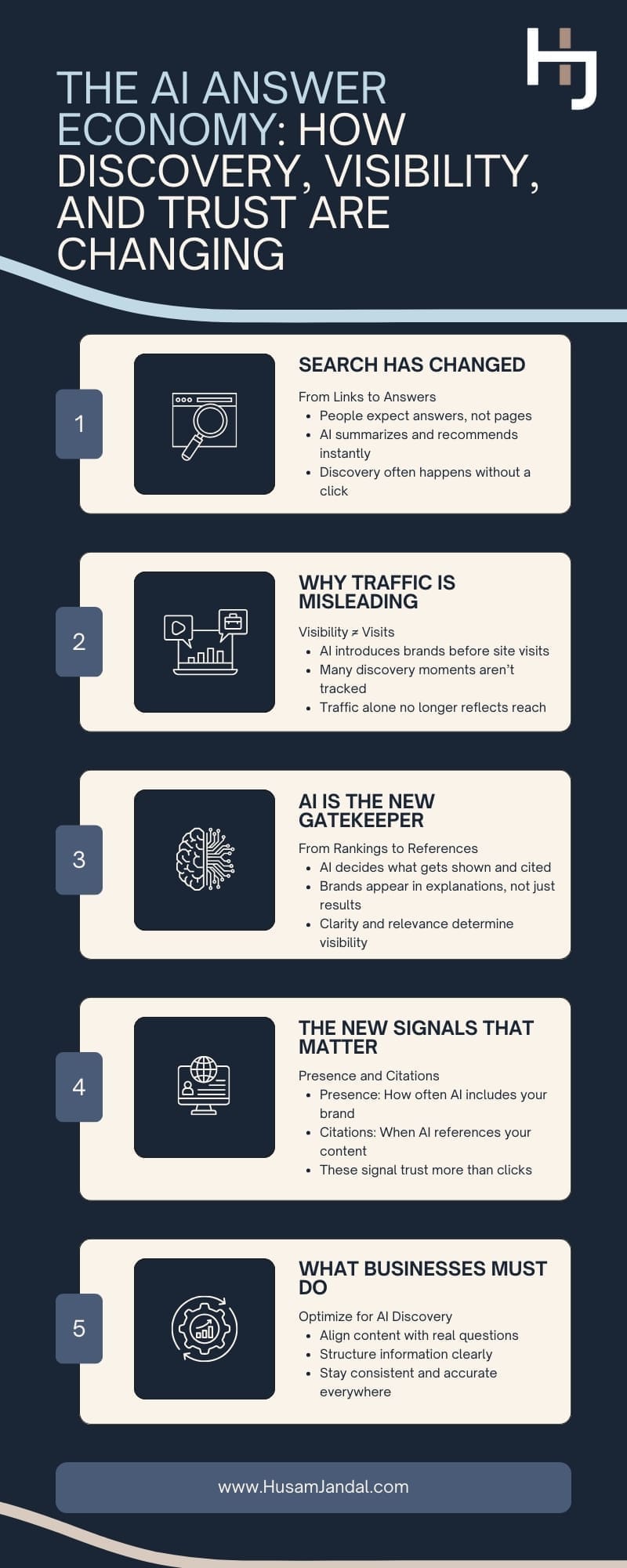
AI-driven visits are expected to outpace human visitors within the next couple of years, according to Semrush. In other words, AI is what now sits between your business and your audience. If you want to reach people, you must be visible to the systems deciding what gets shown, summarized, and recommended.
AI is the Primary Gatekeeper to Discovery
In traditional search, visibility depended on rankings and clicks. In AI-powered search experiences, discovery often happens through answers, summaries, and recommendations delivered before a visit ever occurs. AI tools decide which brands appear in those responses and which sources are referenced to support them.
That makes AI less of a channel and more of an intermediary. It filters information, establishes context, and determines which names surface when someone asks a question related to your business.
Presence Signals That Your Brand is Part of the Conversation
Presence describes how often and how consistently your business appears when AI systems explain a topic, outline options, or walk someone through a decision. This does not require a click, but it does require relevance and clarity.
When your brand shows up repeatedly in AI-generated explanations, it becomes familiar to your audience. Familiarity builds recognition, and recognition shapes trust. For businesses, presence functions much like word-of-mouth did in earlier eras. You may not see the conversation, but you benefit from being part of it.
Citations Indicate Trust and Credibility
Citations take that idea a step further. When an AI system references your business by name or draws directly from your content to support an answer, it signals confidence in the source.
From a business perspective, a citation works like a recommendation. It shows that the system considers your information reliable enough to stand behind. Over time, consistent citation reinforces authority in a way raw traffic never could.
Presence and Citations Matter More Than Clicks
As search behavior becomes more mediated, success shifts from being visited to being referenced. Presence shows that your business is visible within AI-driven discovery. Citations show that it is trusted.
Together, these signals provide a clearer picture of brand influence and awareness in an environment where clicks behave inconsistently. They reflect how often your business contributes to understanding, not just how often someone lands on your site.
Visibility Requires Specific Technical and Strategic Adjustments
To be clear, all of the search engine optimization (SEO), content creation, and other tactics you’ve been using still matter. Humans rely on them, which means their value will never be extinguished. Moreover, all the systems evolving today still rely on them. LLMs read and understand your content, so tactics like keyword integration remain integral for providing them with context. But with AI as the primary gatekeeper, how clearly your information is structured, how directly it addresses intent, and how easily machines can interpret it are essential factors in discovery, too.
Consider Intent as an Organizing Principle
In traditional search, keywords acted as the primary signal for relevance. In AI-driven search, intent plays that role. AI systems focus on understanding the problem being asked, the context around it, and the type of answer required.
This means your business’s visibility depends on how well your content aligns with real questions people ask, not just the phrases they type. Content that explains processes, clarifies tradeoffs, and answers follow-up questions fits naturally into AI-generated responses.
Make Your Content Machine-Readable with Structured Information
AI systems rely on structure to understand and reuse information accurately. Clear headings, logical sections, and consistent formatting help machines determine what your content is about and how it should be summarized.
Technical signals also matter. Standards like Schema.org help AI systems interpret details such as services, locations, authorship, and relationships between concepts. When that information is clearly defined, it becomes easier for AI to surface your business in relevant contexts.
Be Clear and Consistent
AI synthesizes based on patterns it can recognize and trust. When your messaging is consistent across pages and clearly tied to specific topics, it’s easier for AI systems to associate your brand with those subjects.
This is where strategy and execution intersect. Visibility improves when technical structure supports strategic intent and when content is written to be understood by both people and machines.
Continue Focusing on the User Experience
While the strategies covered so far focus on appeasing LLMs, it’s important to remember that real people are still visiting and interacting with your website. Ensuring they have a good experience still matters. Because of this, any tradeoffs between human and machine usability must be carefully weighed. Moreover, the things that people are becoming accustomed to through their ongoing and increased use of AI tools, such as having clear answers at their fingertips, fast response times, and feeling understood, must be addressed on your website.
Businesses Must Prepare for the Next Wave of Autonomous Search and the Future of Search Marketing
AI is no longer limited to answering questions. It is increasingly positioned to take action on a user’s behalf. That shift changes what visibility means and raises the stakes for accuracy, consistency, and trust across your digital footprint.
Search is Moving from Answers to Actions
Early AI search focused on explaining topics and summarizing options. The next phase extends beyond explanation into execution. Instead of asking for information and deciding what to do next, users are increasingly asking systems to complete tasks for them.
That can include researching vendors, comparing options, scheduling appointments, initiating purchases, or preparing recommendations to review later. In these scenarios, AI acts as an agent, not just an interface.
Autonomous Systems Rely on Confidence
When AI performs tasks, it cannot pause to ask clarifying questions the way a human would. It must rely on information that is already clear, current, and internally consistent.
For your business, this means ambiguity carries significant weight. Conflicting descriptions, outdated details, or unclear positioning introduce friction for systems designed to move forward decisively.
Digital Accuracy is a Prerequisite for Selection
As AI systems take on more responsibility, they must decide which businesses are safe to recommend or act upon. Those decisions depend on signals such as clarity of offerings, consistency across sources, and alignment between what a business claims and what is corroborated elsewhere online.
In an autonomous search environment, visibility alone is insufficient. Selection depends on whether your information can be trusted without human verification.
Ensure Your Business Thrives in the AI Answer Economy
Simply put, businesses that treat AI visibility as a present requirement, rather than a future concern, place themselves in a stronger position as autonomous capabilities expand. But knowing where to start and how to maximize efforts in a rapidly evolving field isn’t always straightforward.
As someone who has been involved in digital marketing essentially since the phrase was coined, I’ve supported businesses through countless algorithm and technology shifts. The transition to the AI answer economy is simply the latest evolution—one that I’ve been guiding my clients through since the start, even when AI traffic was no more than a blip in overall traffic. If you’d like to make sure your business is prepared for this shift and beyond, let’s talk.
FAQs on the AI Answer Economy
How do AI-powered search engines work?
AI-powered search engines analyze a question, identify intent, and synthesize information from multiple sources to produce a clear response. Instead of ranking pages alone, they prioritize explanations, context, and trusted sources, delivering answers directly within the search experience.
How do I create a zero-click content strategy?
A zero-click content strategy focuses on providing clear, structured answers that can be surfaced directly in search results. This includes concise explanations, well-organized sections, and content that addresses real questions. The goal is visibility and influence, even when users do not click through to your site.
Do generative AI and SEO work together?
Generative AI and SEO work together by changing what optimization supports. SEO helps AI systems understand, interpret, and trust your content, while generative AI determines how that information is summarized and presented. Strong SEO foundations increase the likelihood that your content will be used within AI-generated answers.
How do I improve brand visibility in AI?
Brand visibility in AI improves when your content is clear, consistent, and structured around user intent. AI systems surface brands they can confidently explain and reference. Visibility comes from being part of the answers people receive, not only from ranking positions or traffic volume.
How should conversational search trends influence my optimization strategy?
Conversational search trends encourage optimization around natural language questions and real decision-making scenarios. Content should reflect how people speak and ask follow-up questions, offering explanations that flow logically. This helps AI systems reuse your content within conversational search experiences.
Does SEO still matter in the AI revolution?
SEO still matters because it provides the foundation AI systems rely on to interpret content. Technical structure, clarity, and relevance help AI understand your business and decide when to surface it. SEO now supports visibility, credibility, and inclusion within AI-driven answers, not just rankings.
How will generative AI change search engine optimization?
Generative AI changes search engine optimization by shifting the focus from ranking pages to contributing usable information. SEO now helps AI systems understand context, intent, and credibility so content can be summarized, referenced, or recommended directly within AI-generated answers.
Will traditional SEO become obsolete in an AI-driven search world?
Traditional SEO will not become obsolete, but its role will evolve. Technical foundations, clear structure, and relevance still matter because AI systems rely on them to interpret content. SEO now supports visibility and trust within AI-driven discovery, not just traffic acquisition.
How can brands stay visible if users stop clicking links?
Brands stay visible by ensuring their information appears within AI-generated answers, summaries, and recommendations. Visibility comes from clarity, relevance, and consistency, which allow AI systems to confidently reference a business even when users never visit the website directly.
What is zero-click content and how does it affect marketing?
Zero-click content delivers answers directly within search results or AI interfaces without requiring a site visit. For marketing, this shifts success from driving traffic to shaping understanding, brand perception, and trust earlier in the decision process.
How do AI systems choose what sources to pull from?
AI systems pull from sources they can interpret clearly and trust consistently. They look for structured information, alignment with user intent, and corroboration across multiple signals. Sources that explain topics well and remain consistent across platforms are more likely to be referenced.
Can companies influence what AI answers say about them?
Companies can influence AI answers by maintaining accurate, consistent, and well-structured information across their digital presence. While businesses cannot control AI outputs directly, clarity, credibility, and alignment with real user questions increase the likelihood of being referenced correctly.