
 If you’ve ever attended the symphony, you know what an awe-inspiring experience it is. You can literally feel the music, whether it’s the dreamlike sounds of the woodwinds, the strings building anticipation, the brass bringing the vibe, or the percussion section marking the moment. You and everyone in the audience are guided through the sensations together, reacting in unison. And, in these moments, you know without a doubt that this is the culmination of a lifetime of devotion to the craft. But what most people don’t realize is that there is someone else in the background helping ensure these moments happen—the orchestrator. They don’t play an instrument, and you won’t see them on stage, but what you experience likely could not happen without them. The same could be said of effective marketing strategy leadership. Give me a moment to explain, and you’ll see what I mean.
The Role of an Orchestrator is Unique
Before we break down why an experienced orchestrator is essential to the success of your marketing, let’s take a quick look at where they fit in.
Contributors and Managers Are Task-Oriented
When you attend the symphony, you see the musicians and the conductor on stage. In marketing, we can liken the roles of musicians to those of individual contributors on a marketing team, such as search engine optimization (SEO) specialists, advertising professionals, developers, and writers. Each contributor specializes in an “instrument.” The conductor is the person on the stage who leads them and keeps them in sync. In marketing, this is what a coordinator or a manager does. They don’t necessarily need to know the specifics of each instrument. They can perform well as long as they keep everyone in sync and momentum flowing.
Owners and Leaders Provide the Vision

In the background, you’ll also have a composer of each piece. This person has a clear vision for what they want to achieve. You can think of them as the ideas person. But in most cases, the composer does not create pieces with a full symphonic orchestra in mind. Their goal is to get the melody on paper so someone can follow it. This is more like the business owner. They’re the visionary and know what they want to achieve.
The Orchestrator Brings it All Together
The role many people overlook is the orchestrator. In music, this person takes what the composer has created and converts it into something the whole orchestra can play, so the audience has a truly immersive and moving experience.
In marketing, the orchestrator transforms the owner’s vision into a strategic blueprint that a marketing team can follow to ensure your prospective customer has a cohesive and impactful experience with your brand.
Someone Must Take Ownership of Aligning Marketing Channels and Results
Have you ever noticed that, when an orchestra is playing, sometimes they’re all playing together in unison, while other times the melody seems to jump from one end of the stage to the other? The orchestrator is the one who determined how it played out.
Similarly, a marketing orchestrator identifies which channels are best. They’ll consider your brand, audience, and capabilities, then map out where it makes the most sense to convey your messaging. A seasoned orchestrator will also ensure each channel works together to reinforce the message, so your audience feels like they’re having the same experience no matter where they are, and the relationship solidifies. It can ultimately lead to a 23 percent gain in revenue, as Forbes reports.
Everyone Must Play Their Role Well in an Integrated Marketing Strategy
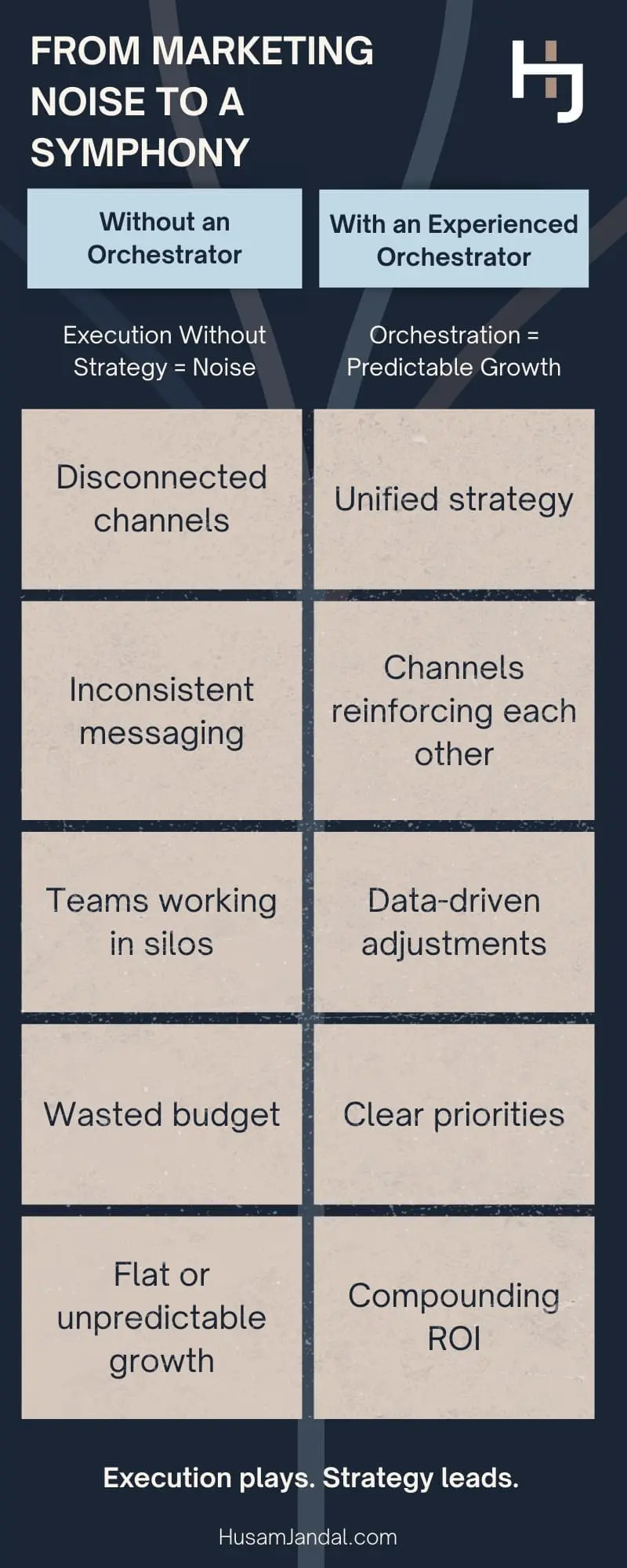
Imagine if each section of an orchestra chose its own song, or even just decided when and how it would play during a song. It would just sound like noise. Thankfully, orchestrators look at the full piece and vision, and use their understanding of each instrument to determine how each one is played. This is what creates the different moods or layers you hear.
The same thing is necessary in marketing. Someone who understands the capabilities of each tool and professional must confirm that each plays its part. This is what helps ensure every touchpoint and step of the customer journey has the right level of coverage and feels natural to your audience. Otherwise, each team and marketing professional may be doing their own thing, and all your audience will hear is noise.
A Seasoned Marketing Strategy Advisor Knows When to Turn Up the Volume
Dynamics and articulation also come into play for a symphonic orchestrator. Dynamics relate to the volume, while articulation is more about how the notes work together to shape expression and mood. For instance, you’ll have some moments where you could almost hear a pin drop, and others that feel so powerful that the audience gets goosebumps. This is all a very measured and intentional approach.
Similarly, a marketing orchestrator keeps a pulse on the data. They understand how the audience is behaving and turn up the volume when a strategy is producing the intended results, keep efforts deliberately tempered while testing, and back off to conserve resources for more effective approaches when something isn’t producing the necessary results. This is key to ensuring you get the best possible return on marketing investment (ROMI) and see measurable business growth that compounds over time.
An Experienced Orchestrator Helps Ensure You Stay Authentic and Build Trust
Another core component of symphonic orchestration is making adjustments to combine sounds or make sections stand out, referred to as blending and contrasting.
This must also be achieved in your marketing. There are certain times you want your messaging to “blend,” meaning you want people to be able to identify what you do at a glance. That means using the types of words and imagery your audience associates with brands like yours because it’s familiar and creates comfort. There are other times your prospective customers must see the contrast between you and your competitors. A good marketing orchestrator will get to know your business and your industry so that these moments can be handled with authenticity and build trust.
Your Business Gets Proven Strategies Tailored for Your Needs
Because symphonic orchestrators have a deep understanding of music theory and each instrument, they can also adapt pieces to suit a different audience. For instance, if you watched the Trolls movie, you caught pop songs adapted for kids. Many skilled artists today convert heavy metal songs into lullabies, rock music into barbershop quartet tunes, and more.
Because marketing orchestrators have a similar deep understanding of their field, they can take proven strategies and adapt them to suit your brand, vision, and the needs of your audience. Moreover, a seasoned marketing strategist can build strategies that scale. For instance, my Digital Marketing Tree philosophy is proven to work for Fortune 100 companies, but it’s adapted to suit small and mid-sized companies, and you can increase the power of your marketing engine as your business grows.
Get Help with Your Marketing Orchestration
Business owners often follow one of two paths when it comes to marketing orchestration: they either try to manage it themselves or the role is addressed by a trusted vendor or employee. The problem here is that you’re the visionary, and your business relies on you in many other ways. Splitting your focus often means something falls by the wayside. And, unless you have a background in marketing, you may not know all the tactics that can be leveraged to drive results. Similarly, even a trusted vendor who excels in one area may not have the full breadth of marketing expertise to ensure other areas receive the attention they deserve. Key team members may understand your business almost as well as you do, and this makes them invaluable on your marketing team, but without proper mentorship and guidance, they won’t be able to produce the same level of results as a seasoned marketing orchestrator will. With the right person at the helm of your marketing strategy, they may be able to someday.
If you’re sitting at a crossroad and aren’t getting the results you need or don’t have someone who can bring a high level of proficiency to all the areas outlined here, let’s talk.
FAQs on Marketing Strategy and Leadership
Should I hire a fractional CMO or a marketing agency?
Agencies are often "Jacks of all trades" that lack specialized mastery in every area. A fractional CMO is usually better for scaling companies because they provide strategic leadership as an "insider.” This follows the proven recipe of keeping strategic control in-house while outsourcing tactical roles to specialized masters of each "instrument."
How do I unify multiple marketing channels under one plan?
Unification requires an integrated marketing framework that aligns your website, social media, email, and ads under a single strategic blueprint. Start by centralizing data and using a content marketing calendar to ensure consistent messaging. An experienced orchestrator ensures these channels reinforce one another to solidify customer relationships and brand recall.
What are the risks of siloed marketing teams?
Siloed teams create fragmented "noise" that confuses customers and erodes brand trust. The primary risks include wasted resources, inconsistent customer experiences, and a failure to meet business objectives because departments work toward different goals. Without an orchestrator to align these silos, businesses miss the compounding effects of integrated growth.
How does orchestration improve marketing ROI?
Orchestration improves ROI by using data to manage "dynamics"—scaling high-performing tactics while backing off from strategies that yield poor results. By converting vision into a technical blueprint, it eliminates wasted spend on uncoordinated efforts and ensures every dollar invested supports a structured system for predictable, compounding business growth and revenue.
What’s the difference between execution and orchestration?
Execution is task-oriented management performed by "musicians" (specialists) and "conductors" (managers) who keep teams in sync. Orchestration is the architectural role that creates the strategic blueprint they follow. While execution focuses on playing the notes correctly, orchestration determines which notes should be played to transform a vision into revenue.
How do I align marketing with business strategy?
Alignment begins by setting SMART business goals that define the company's long-term vision. An orchestrator then serves as the bridge, translating those broad objectives into a tactical marketing blueprint. This ensures every campaign and channel is technically "hard-wired" to deliver results that directly influence the health and profitability of the organization.
Who owns marketing strategy in a scaling company?
In a scaling company, strategic ownership should remain at the heart of the business rather than being outsourced to a general agency. While contributors can be external, the orchestrator role—either an in-house leader or a fractional CMO—must own the strategic blueprint to ensure the marketing engine remains aligned with the owner's vision.


































































Husam Jandal
Husam Jandal is an internationally renowned business and marketing consultant and public speaker with a background that includes training Google Partners, teaching e-business at a master’s level, receiving multiple Web Marketing Association Awards, and earning a plethora of rave reviews from businesses of all sizes.