 Marketing budgets are often first on the chopping block when sales slump or during economic uncertainty. In a way, it makes sense because it seems less urgent than covering things like payroll or purchasing supplies. But the reality is that, if you’re considering cutting your marketing budget, what you’re really doing is putting the future of your business at risk and making it that much harder to cover the other essential expenses later. Moreover, it’s absolutely unnecessary, and I’m not saying this as a digital marketing consultant. My background is in business. Digital marketing is just one of the tools I leverage to help businesses achieve their growth goals.
Give me a few minutes, and I’ll walk you through why cutting your marketing budget is the last thing you want to do, and what you can do instead if you’re facing hard decisions or simply trying to boost your business’s resilience.
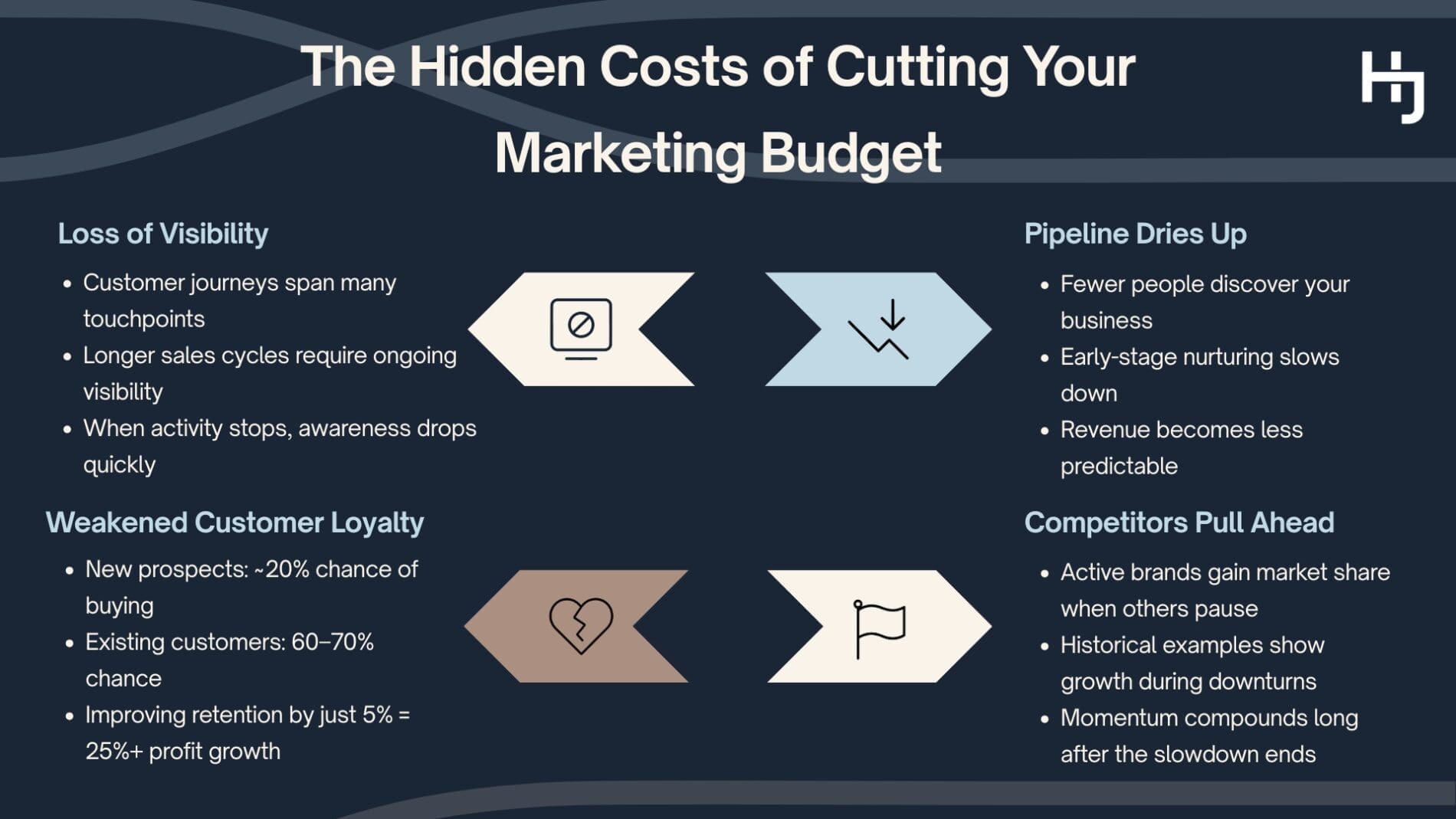
4 Reasons Cutting Marketing Budgets Harms Long-Term Business Health
Many people think of marketing as something you can turn on or off, like a faucet. When you’re ready for more leads and sales, you simply turn up the volume. While certain digital marketing tactics, such as pay-per-click (PPC) advertising, can work that way, the type of marketing that creates lasting results and builds strong, healthy brands does not. Turning it off comes with immediate consequences and opportunity costs with long-term implications.
1. You Lose Visibility
Now more than ever, customer journeys are expansive and involve multiple touchpoints. Naturally, you’ll also see longer cycles with sales and services at higher price points, those that require longer commitments, and when the product or service is not purchased often. It’s within these niches that staying continuously visible is paramount, regardless of whether your buyer intends to buy today, tomorrow, or six months from now.
2. Customer Relationships and Loyalty Falter
The probability of selling to a new prospect maxes out at around 20 percent, according to Forbes. Existing customers, however, will purchase 60 to 70 percent of the time. Not surprisingly, this also means that brands that retain customers have stronger performance. Just a five percent lift in retention can boost profits by more than 25 percent, according to Bain & Company.
Clearly, retention is key to growing a thriving business, but even the most loyal customers are unlikely to stick around unless you continue to give them reasons to. In other words, your brand must continue to deliver value. That can come in the form of special promotions, regular outreach, community building, or even sharing educational content. Each method has its place. However, if these activities cease altogether, your brand no longer stays top of mind, and the perceived value of your offerings diminishes. Your hard-earned relationships fade with it.
3. Your Pipeline Dries Up
A steady pipeline depends on consistent engagement. New prospects enter at different stages, and each touchpoint shapes how they move forward. When marketing activity slows, fewer people discover your business, fewer enter early-stage nurturing, and fewer reach the point where they are ready to buy. Your funnel becomes thin at the top, and every stage beneath it weakens.
This impacts growth in two ways. First, sales teams have fewer active conversations, which limits opportunities. Second, future revenue becomes unpredictable because you have fewer prospects working through the natural progression from awareness to purchase. A consistent pipeline shields your business from volatility and gives you room to plan, invest, and make confident decisions, but that can’t happen effectively when you cut your marketing budget.
4. Competitors Pull Ahead
Competition shifts quickly during uncertain periods. Some businesses scale back their marketing, which reduces the amount of information customers see overall. When this happens, brands that continue investing gain a stronger presence in the market. Their messaging carries farther, their offers gain more attention, and their audience grows while others pause.
Reckitt Benckiser is a prime example here. When everyone else was cutting back after the 2008 financial crash, the company increased its advertising outlays by 25 percent, as Harvard Business Review (HBR) reports. When their competitors began reporting profit declines of ten percent or more, they saw a 14 percent lift and grew revenue by eight percent.
This kind of momentum compounds. Businesses that remain active during challenging periods position themselves for faster recovery, stronger customer recall, and a greater share of future demand.
What to Do Instead of Cutting Your Marketing Budget
At this stage, we’re likely on the same page about cutting your marketing budget. It’s not a suitable idea when you’re focused on the long-term success of your business. But the reality is that you will have conflicting priorities and, sometimes, there has to be give-and-take to make your business budget work. When these moments arise, the strategies below can help guide you and ensure your business maintains momentum.
Ensure Data is at the Heart of Your Marketing Investment Strategy
Data gives you a clear picture of what is working and where your next opportunities sit. It helps you understand which channels bring in higher-value customers, which messages create stronger engagement, and where your team should focus its attention. With this level of clarity, your budget becomes intentional. You put your resources behind the strategies that support long-term growth instead of making decisions based on assumptions.
Your timing is also strengthened with data. When you track changes in engagement, acquisition cost, or customer behavior, you start to see patterns that point to your next move. This helps you stay ahead of shifts in the market and gives your business a steadier path forward.
Shore Up Your Business Resilience Strategy
A resilient business stays steady through shifting priorities because it has both the financial strength and the strategic vision to support long-term growth. This comes from improving the financial systems that influence cash flow and from continuing to invest in the ideas that move your business forward. When these areas work together, you feel less strain and have more room to maintain your marketing activity, refine your offers, and pursue new opportunities.
Shorten Your Cash Conversion Cycle
Your cash conversion cycle (CCC) shows how long it takes to turn a sale into cash your business can use. When this cycle is shorter, you feel less pressure on the rest of your budget because money is returning to you faster. This might come from tightening your billing processes, improving collections, or finding small efficiencies in how work moves through your business. Even modest improvements can free up cash, which gives you more room to keep your marketing steady while still supporting day-to-day operations.
Amazon is a powerful example of how this works in action. Think back to the dot-com bust. It’s estimated that thousands of companies folded. Amazon didn’t, and its resilience is often credited to the fact that it had a negative cash conversion cycle—it took money in before it paid money out. While your business may not be able to attain a negative CCC, the shorter yours is, the easier it will be to cover all your expenses while maintaining a healthy marketing budget.
Continue to Invest in R&D
Innovation strengthens your market position and gives your business more ways to create value, even when conditions feel tight. Research and development (R&D) helps you refine your products, improve your delivery model, or introduce new solutions that meet changing customer needs. These shifts can open new revenue streams, increase efficiency, or strengthen your competitive edge.
History offers many examples of why continued investments in R&D are essential. For instance, during the Great Recession, Hostess modernized its factories and warehouse-based delivery system, expanding the company’s reach while cutting delivery costs from 36 to 16 percent of revenue, as CB Insights reports.
And while it may seem counterintuitive to launch a new product during a recession, businesses across industries, from fast-moving consumer goods to automotive, see higher long-term survival rates and higher sales revenues from launching in difficult times, per HBR reports. While it may be challenging to triangulate as it’s happening, researchers say the best time to launch a new product is just after the mid-point of a recession because people are starting to think about their next big purchase, even if they’re not quite ready to buy.
Revenue Optimization
Revenue optimization helps your business make the most of the demand you already have. Instead of relying on cuts to create relief, you strengthen the parts of your operation that influence how revenue is captured, priced, and sustained. There are many ways to optimize revenue, such as refining your offer structure, improving your sales process, or expanding complementary services that make each customer relationship more valuable.
When revenue becomes more predictable, and each transaction carries greater weight, your business feels steadier. You have greater budget flexibility, which makes it easier to maintain your marketing commitment without straining other areas. Over time, these adjustments compound. Stronger margins, better upsell pathways, and clearer value alignment give your business the capacity to invest in growth even when conditions shift.
Focus on Your Top Performers

Your strongest opportunities often come from the strategies, channels, and offers that already deliver meaningful results for your business. When budgets are tight, focusing on these areas has a greater impact than spreading resources across initiatives with weaker returns. This might include prioritizing products with higher margins, audiences that convert reliably, or marketing channels that consistently bring in high-value customers.
Automate and Outsource Where You Can
Automation and outsourcing help you maintain consistency when your internal capacity is limited. You can use automation to keep tasks like lead follow-up, reporting, and customer communication moving without delays, which reduces the drop-off that happens when teams are stretched thin. Outsourcing achieves something similar. It gives you access to experienced specialists who can manage key functions without adding to your headcount or slowing down your operations. Together, these approaches help your business stay responsive and active in the market, even when your team is busy or resources feel tight.
Go Where the Market Takes You
Markets shift, and the way customers behave shifts with them. When you pay attention to those patterns, new opportunities become clear. This is what happened with Priceline. The company entered the market focused on airlines, but after travel demand collapsed, it recognized that hotels were gaining traction. Pivoting toward that segment became the foundation of its long-term growth.
YouTube followed a similar path. It launched as a dating website, yet user behavior pointed in a different direction. People were using the platform to share and watch short videos, so the company leaned into that demand instead of the original plan.
When you stay close to the market and respond to where customer interest is moving, you open the door to new revenue streams and stronger performance. These shifts do not require a full reinvention. They simply require a willingness to follow the demand that is already forming.
Strengthen Your Owned Channels
Owned channels are the places where you control the message and the relationship. This includes your website, email list, content library, and any communities you manage directly. Because you are not relying on shifting algorithms or rising platform costs, these channels give you reliable ways to reach your audience and keep conversations moving.
When these areas are strong, your business stays connected to customers even when you are adjusting budgets elsewhere. A clear message on your website, a helpful email sent at the right time, or valuable content that answers real questions can carry a lot of weight. These channels help you stay visible, reinforce trust, and create steady pathways for future sales.
Build Your Brand Equity
Brand equity strengthens every part of your business. When your brand is clear, consistent, and meaningful, customers understand who you are, what you offer, and why you are the right choice. This clarity reduces friction in the buying process and creates trust long before a sales conversation begins. It also lowers acquisition costs because people respond more readily to brands they recognize and feel connected to.
Strong brand equity pays off in challenging periods, too. A memorable story, a distinct point of view, and consistent communication make your business easier to choose, even when customers are being more selective. Over time, these elements compound. They shape how people talk about your business, how they compare you to competitors, and how confident they feel investing in what you offer.
Improve Customer Lifetime Value
Many businesses react to revenue pressure by raising prices, then launching promotions when customers pull away. This see-sawing actually costs businesses market share, as HBR reports. A more effective approach is to increase the value each customer brings to your business without shifting the price point.
Your CLV grows when you give customers additional ways to work with you and clearer reasons to stay longer. This might include complementary services, helpful communication, smoother onboarding, or benefits that make their experience more complete. These improvements strengthen loyalty, create more predictable revenue, and give you a healthier base of support for your marketing commitments, even when conditions feel tight.
Double-Down on Micro Content
Micro content gives your business a steady presence without requiring large budgets or long production cycles. Short, helpful pieces, such as quick insights, bite-sized educational posts, or brief how-tos, keep your audience engaged and reinforce your expertise in a format people can absorb easily. Because these pieces move quickly from idea to publishing, they help you stay responsive to what customers are thinking about right now.
This approach also supports every other marketing effort you invest in. Strong micro content strengthens your brand message, improves search visibility, and gives customers more touchpoints to learn from you. Over time, these smaller pieces build trust and make your longer-form content, offers, and sales conversations more effective.
Be Relatable and Engage Your Audience with Storytelling
Storytelling helps your audience connect with your business on a human level. While micro content keeps you present and visible, stories give your message depth. They show the people behind your business, the values you operate from, and the real experiences that shape your work. When customers see themselves in these stories, they build stronger emotional ties and trust your guidance more readily.
This approach can be especially effective during times of change. Coca-Cola demonstrated this in 2020 when it highlighted frontline workers through simple, meaningful stories. The brand remained present without drawing attention away from the moment, and the message reinforced its role in people’s lives. Your business can do the same. When your stories reflect real challenges, real customers, or real outcomes, your audience stays engaged and sees greater value in the relationship.
Grow Through New Partnerships
Partnerships open new pathways for growth without relying solely on paid channels or increased internal capacity. When you collaborate with the right organizations or individuals, you gain access to audiences that already trust their recommendations, which shortens the path to engagement and strengthens your market presence.
Build a Strong Referral Partner Network
Referral partners create a direct line to new customers by introducing your business to people who rely on their guidance. Because these recommendations come from someone the customer already trusts, the path to conversion is shorter, and the relationship begins with more confidence. This makes referral partnerships one of the most cost-effective ways to expand your reach. A strong network also diversifies your lead flow, which gives your business more stability when the market shifts or when paid channels become expensive.
Collaborate with Content Partners
Content partnerships help you reach new audiences through shared expertise. When another brand, creator, or industry expert features your insights, their audience becomes familiar with your voice and the value you provide. This type of partnership often strengthens credibility because you are being introduced through someone the audience already respects. Over time, these collaborations widen your reach, increase your authority, and create momentum that supports both your brand and your marketing efficiency.
Consider Strategic Marketing Budget Increases
A strategic increase in your marketing budget can elevate your presence at a time when customers are paying closer attention. We saw how effective this can be earlier when we covered Reckitt Benckiser. The brand strengthened its position by increasing its advertising investment while competitors scaled back. Kellogg’s is another strong example. After the 1929 market crash, the company doubled its advertising budget and reinvested in its workforce. By 1933, Kellogg’s increased its profits by 30 percent and emerged as the country’s leading breakfast brand, per CB Insights.
These examples reinforce an important point. When your business has the data, the financial capacity, and the discipline to support it, a well-timed increase in marketing can create long-term momentum and set you apart from competitors who retreat.
Get Help Improving Your Long-Term Marketing ROI
If you’ve come to the conclusion that cutting your marketing budget isn’t the right path for your business, and you’re now focused on obtaining maximum return on investment (ROI), but aren’t sure how to apply the strategies I’ve covered here or want a holistic approach that examines multiple aspects of your business, let’s talk. Connect with me for a complimentary consultation.
FAQs on Cutting Marketing Budgets
Should I cut my marketing budget during a recession?
Cutting your marketing budget reduces visibility, slows your pipeline, and makes it harder for customers to choose you when demand returns. A consistent presence gives your business an advantage as competitors retreat and helps you maintain the momentum needed for long-term growth.
What is the impact of budget cuts on a brand?
Budget cuts weaken visibility, create gaps in customer engagement, and limit your ability to shape how people perceive your business. Over time, this can reduce trust, slow growth, and make it harder for your brand to remain part of your customers’ consideration set.
How should I approach marketing during a recession?
A strong approach focuses on visibility, retention, and strategic efficiency. Maintain the channels that keep you connected to customers, strengthen your owned assets, and invest in the strategies that deliver the highest long-term value. This approach keeps your brand active and supports stability as conditions shift.
What happens when companies stop advertising?
When advertising stops, a brand fades from customer awareness. Competitors gain more attention, pipelines shrink, and sales become less predictable. Maintaining even a reduced presence helps your business stay part of the buying conversation and strengthens your position when demand improves.
Is it smart to invest in marketing when sales are down?
Investing when sales are down can help your business recover faster. Marketing brings new prospects into your pipeline and strengthens customer relationships at a time when engagement is essential. A steady presence positions your business for growth when demand rebounds.
How do I prove the value of marketing to my CFO?
Show how marketing supports revenue through data on lead quality, conversion rates, customer lifetime value, and cost efficiency. Clear visibility into the pipeline and consistent tracking make it easier to tie marketing activity to financial outcomes and demonstrate long-term return.
What is the ROI of brand building in a downturn?
Brand building becomes more efficient in a downturn because fewer competitors are active. Your share of voice increases, customer trust strengthens, and acquisition costs often improve. These gains compound over time and position your business for faster growth when the market stabilizes.
How can companies grow when everyone else is cutting back?
Growth comes from staying visible, strengthening customer relationships, and focusing on the strategies that deliver the most value. When competitors pull back, your message travels farther, which gives your business more attention and creates opportunities that are harder to secure in crowded markets.
What marketing strategies work best during uncertainty?
The strongest strategies focus on visibility, retention, owned channels, and consistent communication. Complementary services, micro content, and clear brand storytelling also help your business stay relevant. These approaches maintain customer engagement and support long-term growth, while others reduce their presence.
How do I prioritize spend without killing momentum?
Prioritize the channels and offers that bring your highest-value customers and strongest returns. Strengthen your owned assets, improve retention, and use data to guide your decisions. These steps keep momentum steady while helping your business stay focused on the strategies that matter most.
Growth vs. cost-cutting: What is more important during a recession?
Growth-focused strategies put your business in a stronger position for the rebound. Cost discipline matters, but cutting the channels that drive visibility and engagement slows recovery. A balanced approach that protects marketing and strengthens operational efficiency delivers the greatest long-term advantage.