 What’s your goal for pay-per-click (PPC) advertising? If you’re like most, your mind instantly went to getting a click. You want that person to become a lead. You want the opportunity to sell to them and the opportunity to close that deal. But what if you’re only running half the marathon with your PPC lead generation? What if the actual value is not just in selling to that person now, but is in having them in your customer relationship management (CRM) software or database?
It may sound counterintuitive, but give me a moment, and I’ll walk you through why it’s time to rethink where you set the finish line.
Building Out Your Database Offers Benefits Beyond the Immediate Click
Statistically, the odds of selling to a new prospect are somewhere between 5 and 20 percent, as Forbes reports. That means most of the leads you add to your database will not close. But regardless of whether they eventually become customers, there’s still value in adding them to your database.
You Gain Access to Zero-Cost Remarketing and High-Margin Revenue
The average number of touchpoints before a sale is closed is widely debated. Some sources say it’s six or seven. Others indicate it’s closer to 30. There are even reports of certain customer journeys including more than 200 touchpoints. Regardless of the exact figure, we do know that most leads will not lock in with your company the first time they’re introduced. And the greater the investment is, whether you’re considering the raw costs or the pain of switching later, the number of touchpoints increases.
This is one of the greatest challenges in B2B markets because you’re not likely to close the sale today or even tomorrow. In fact, the median B2B sales cycle is just over two months, per Databox. Nearly one in ten won’t even close within five months.
PPC tactics like paid search are strong options for reaching people and generating these initial leads. In fact, the average cost per click (CPC) for Google Search Ads is a little more than $5, according to WordStream. The return on investment (ROI) is 800 percent on average, meaning you get back $8 for each $1 spent.
But it’s important to remember that you’re really only renting their attention with these ads. The moment you stop advertising and paying for each click, you vanish from sight, and often from their minds. That’s concerning because, as we’ve just touched on, they need much more engagement with your brand before they close.
However, once a prospect is in your database, you no longer have to pay Google, Meta, or LinkedIn to rent their attention. You can reach them anytime for a fraction of the cost through email marketing. Instead of paying $5 per engagement with your brand, it’s literally pennies. Moreover, ROI jumps to an average of $10 to $36, according to Litmus. This reduces your overall customer acquisition cost (CAC) and opens doors for revenue growth.
Moreover, it’s significantly cheaper to sell to an existing contact than to a stranger. Your database allows you to cross-sell and upsell, which directly boosts your profit margins because the marketing cost for that second sale is effectively zero.
You Produce Algorithmic Fuel
When you run a Paid Search campaign, you’re collaborating with artificial intelligence (AI). Google’s algorithms are incredibly adept at finding your ideal customer, but they need data to do it. You can give them time and money to figure it out on their own, or you can shorten the learning curve and cost by providing them with the data they need.
- Customer Match: By uploading your existing database to Google, the system matches your contacts to logged-in Google accounts. This allows you to re-engage people who haven’t yet converted, keeping your brand top of mind and lowering your cost per acquisition (CPA).
- Lookalike Segments (AI Signals): Previously used as a strict cloning tool to find similar users, Lookalikes have evolved into AI-powered signals. Your database now acts as a compass, guiding the algorithm to find new, high-intent strangers who share the digital DNA of your best customers while allowing the AI to expand reach when it spots a high-value opportunity.
- Offline Conversion Tracking: This closes the loop by sharing data back from your CRM to show which leads actually became paying customers. It teaches the algorithm to stop bidding on those with casual interest and focus your spend on the specific types of people who actually become customers and drive revenue.
It’s worth noting, however, that these tools perform better when you provide them with more data. With greater volume, AI can connect more dots and identify stronger matches. And, in some cases, you need to meet minimum volume requirements to be able to use them at all. For instance, Lookalike audiences can only be used if your seed lists have at least 100 active users, Google reports.
You Gain Market Intelligence and Predictive Analytics
Beyond the immediate sales and the technical advantages for your ads, a full database serves as your company’s private laboratory. Most business owners are forced to look outward by evaluating competitors or reading general industry reports to figure out what to do next. When you have a robust database, you can look inward at your own data to lead the market instead.
- Spot Trends Before the Industry Does: Your database is a living record of customer intent. By analyzing the behavior of your contacts, you can identify micro-trends in your specific niche months before they show up in a trade magazine. This allows you to pivot your messaging, update your service offerings, or create a targeted Paid Search campaign around specific trends while your competitors are still running generic ads.
- Segment for Precision Growth: When you have a large database, you can slice the data to see exactly where your highest growth potential lies. For instance, you might notice that customers within a specific industry have a higher customer lifetime value (CLV) than others, or that certain keywords used in your Paid Search campaigns result in greater profit, allowing you to focus your investments on growth-producing segments.
- Focus Sales Efforts: With predictive analytics, your historical database can be used to assign a probability score to new leads as they come in, so sales reps can spend their time on high-probability leads while nurturing workflows guide the rest.
Business Valuation May Increase
If you ever decide to sell your company or seek outside investment, the offer you receive will be heavily influenced by your proprietary data because it can tell the story of current and future profit.
- Predictable Revenue: A full database proves that you have a backlog of potential revenue. You can show a buyer exactly how many people are currently in your nurture sequence and prove how many are likely to become customers.
- Goodwill and Brand Equity: Your database demonstrates the level of goodwill and brand equity you have, turning them into tangible assets.
- Risk Diversification: By building your database through Paid Search, you’re systematically moving your business’s value off of a third-party platform and onto your own servers. This diversification of lead sources significantly lowers your risk profile, which in turn drives up your valuation.
- Probability of Success: Because you’ve used your database to train your ad algorithms, the intelligence of your marketing is baked into your systems. You’re selling a self-optimizing system, not just a company.
You Can Personalize at Scale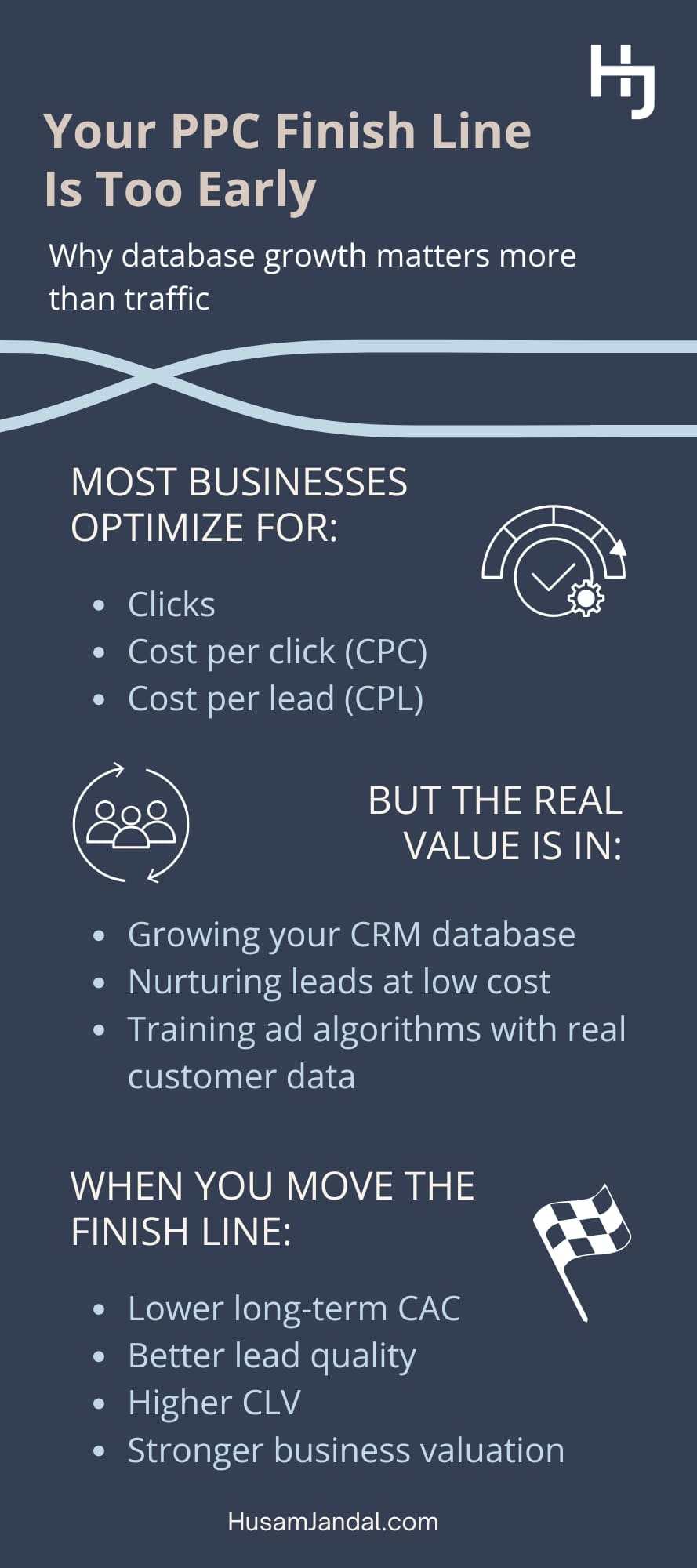
Businesses that excel at personalization generate 40 percent more revenue from those activities than their counterparts, according to McKinsey. When you have a full database integrated with your Paid Search efforts, you can achieve personalization at scale. This means delivering the right message to the right person at the exact moment they need it, all without lifting a finger.
- Improve Segmentation: When your database is full of behavioral data, such as what people clicked, what they downloaded, and how long they stayed on a page, you can segment and ensure your communication is contextually relevant. For instance, you might segment by industry or pain point.
- Use Trigger-Based Automation: Because your database is linked to your website tracking, it can act as a 24/7 concierge for your leads. You can set up automated triggers based on what a person does or doesn’t do. For instance, if someone visits your pricing page twice in a day, your system can alert a sales rep to contact them. You can also send personalized messages to people who return to your site after a period of silence.
- Create Dynamic Content and Custom Journeys: When you understand your contacts at a deep level, you can use dynamic content and change what a user sees based on it. For instance, your website might display reviews and case studies that match the visitor’s industry or role. Or, you might move a lead through a drip campaign that changes based on their engagement.
Investments in PPC Must Reflect the Total Value of a Lead
Earlier, I mentioned that the average CPC on Google Search is around $5. This is only part of the equation. The average cost per lead (CPL) is just over $70. And, in some industries, you’ll have CPLs in the hundreds. Oftentimes, business leaders hear these figures and think the overall cost is too high, and that Paid Search is not worth the expense. But the view changes once the true value of a lead is understood.
CLV Must Be Taken into Consideration
Many formulas used to measure customer lifetime value are tied only to metrics such as gross margin and retention rate. I prefer to use a simplified CLV formula that considers tenure and volume, as well as one other often-overlooked value multiplier: referrals. After all, happy customers refer more happy customers. Moreover, those customers tend to spend more and maintain relationships more easily, which dramatically improves lifetime value, too.
When you start with a more accurate CLV, it’s easier to see that even seemingly high acquisition costs are sound investments that contribute to your growth. Knowing your CLV also allows you to reverse-engineer your budget, so that you can raise the ceiling on your bids to ensure you’re capturing high-value, high-intent, high-probability leads, and not just what’s left behind after your competitors are done bidding on what works.
Data Brings Additional Value
Even the leads that don’t close today have a tangible cash value that most businesses ignore. As we’ve covered, every lead added to your database contributes to the algorithmic fuel and market intelligence, allowing you to apply your resources more effectively and improve your ROI.
- Lower Future Costs: A lead in your database today makes your ads cheaper tomorrow by enabling Lookalike modeling and better AI training.
- Creating Zero-Cost Touchpoints: If a lead doesn’t close immediately but stays in your database for a year and receives monthly emails, they may eventually close a high-margin deal. The value of that lead includes all that future potential.
Get Help Strengthening Your PPC Lead Generation and Database
Many businesses set their sights on PPC lead generation and focus only on running the ads. In reality, you must address the full funnel to have success with this approach. That means having a PPC specialist, web developer, analytics professional, and someone with the technical expertise to ensure your database is set up properly and that leads are managed effectively. To maximize the value, you’ll also likely need the help of an email marketing specialist, copywriter, and graphic designer. That’s not to say you need to fill these roles with full-time in-house specialists. Most, if not all, the tasks can be managed through an on-demand workforce, which ensures each task is being handled by an expert while keeping your overhead low.
However, orchestrating all this, ensuring it comes together properly, and refining over time to improve the results requires time most business leaders don’t have. That’s where someone like me can step in. As a digital marketing consultant with a background in business, I help build systems like this and ensure you have the right talent to achieve optimal results. If you’re interested in exploring what that might look like for your business, let’s talk.
FAQs on PPC Lead Generation and Growing Your Database
Is using paid search for lead generation worth it?
Absolutely. Paid search allows you to intercept high-intent users at the exact moment they seek a solution. While the upfront cost can seem high, the ability to rapidly populate your database with qualified leads, which can be nurtured for years at near-zero cost, provides a massive long-term return on investment.
What are the key PPC conversion tactics?
Success lies in alignment. You must match your ad copy to high-intent keywords and direct that traffic to a dedicated, high-converting landing page. Utilizing strong lead magnets like white papers or webinars, implementing one-click forms, and using remarketing to bring back bounced visitors are essential tactics for converting traffic into data.
Why should I build a lead database with PPC?
PPC gives you speed, but your database gives you stability. By using paid ads to fuel your CRM, you transition from renting attention to owning it. This owned data allows for personalized marketing, trains your ad algorithms, and protects your business from rising ad costs or platform changes.
How can I use my database to improve my B2B paid advertising strategy?
Your database acts as a blueprint. You can upload your customer lists to create Lookalike Audiences and find strangers who share the same professional traits as your buyers. Furthermore, feeding closed-won data back into the platform teaches the AI to prioritize high-value decision-makers over low-level researchers or people who won’t convert.
How do you use PPC for demand generation?
For demand generation, focus on informative, low-friction content. Use PPC to promote educational assets, such as industry reports or how-to guides, rather than direct sales pitches. This builds brand authority and captures contact information early, which allows you to create a need for your services within your growing database.
How can PPC help grow my email or lead database?
PPC acts as a high-speed funnel. By bidding on problem-solving keywords and offering a valuable gated resource in exchange for an email address, you can add hundreds of qualified contacts to your list weekly. This is far more efficient and scalable than waiting for organic traffic to discover your site.
What’s the best way to optimize PPC for lead generation?
Stop optimizing for the click and start optimizing for the conversion. This involves aggressive keyword pruning to remove low-intent traffic, A/B testing your landing page offers, and using value-based bidding. By focusing on the leads that actually close, you ensure your budget is spent on revenue, not just vanity metrics.
Should I use Google Ads or LinkedIn for B2B lead capture?
Both are powerful, but they serve different intents. Google Ads is best for active demand or catching people specifically searching for a solution. LinkedIn is superior for target-based demand, allowing you to reach specific job titles or companies even if they aren't searching. Use both to capture the widest net.
What landing page features improve PPC conversion rates?
The most effective pages prioritize clarity and speed. Key features include a singular call to action (CTA), social proof like testimonials, and a mobile-optimized layout. Minimizing form fields and ensuring your headline perfectly matches the ad that brought the user there will significantly decrease your bounce rates and increase sign-ups.
How do I track leads from PPC all the way to revenue?
You must implement offline conversion tracking by linking your CRM to your ad account. By passing a unique Click ID (GCLID) from your lead form into your CRM, you can notify Google when that specific lead becomes a sale. This creates a closed-loop system that measures actual profit.
How can PPC be optimized for lead generation rather than just traffic?
Shift your focus to negative keywords to filter out job seekers or students and implement enhanced conversions to track lead quality. Rather than rewarding the algorithm for every visitor, only reward it for users who complete your lead form. This trains the AI to find converters instead of browsers.
What PPC conversion rates should I expect for lead capture campaigns?
While rates vary by industry, a healthy B2B lead generation campaign typically sees conversion rates between two and five percent. However, high-performing lead magnet pages can often reach ten percent or higher. Your goal should be to consistently improve your baseline through continuous A/B testing and offer refinement.
How do I build a PPC campaign that feeds directly into my CRM?
You can use native Lead Form Extensions within Google or LinkedIn that automatically push data to your CRM via API or tools like Zapier. Alternatively, ensure your website forms are mapped to your CRM fields, including a hidden field to capture the GCLID for full-loop revenue tracking.
What parts of the funnel should PPC support to grow a lead database?
PPC should support the entire funnel. Use top of funnel ads to capture emails with educational content, middle of funnel ads for webinars or case studies to gauge intent, and bottom of funnel ads to convert high-intent searchers. This multi-layered approach ensures your database is always growing.